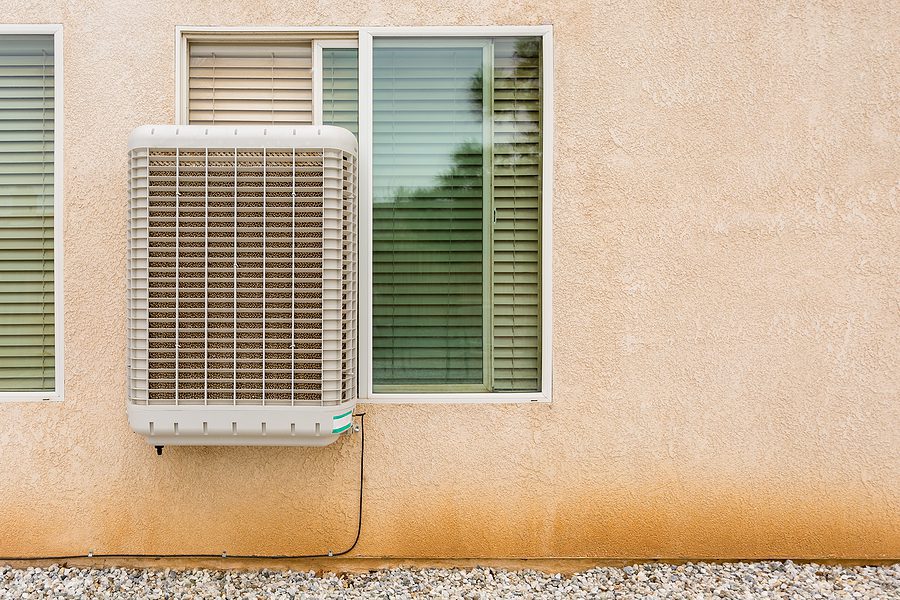
A swamp cooler may stop blowing cold air when the cooling pads are not getting enough water, the pads are dirty or worn, the water pump is failing, airflow is restricted, the blower or belt has a problem, mineral buildup interferes with water distribution, or outdoor humidity is too high for effective evaporative cooling. Some causes are routine maintenance issues; others require professional repair.
If your swamp cooler is running and you can hear the fan, but the house still feels warm, that does not automatically mean the entire cooler has failed.
A better way to troubleshoot the problem is to think about the five things an evaporative cooler depends on:
Water + Wet Pads + Airflow + Mechanical Operation + Weather Conditions
If any one of those is missing or significantly reduced, cooling performance can suffer.
That troubleshooting approach is particularly useful in Albuquerque, where evaporative cooling remains common and local conditions such as high-desert weather, summer heat, hard water, mineral buildup, and seasonal humidity changes can affect swamp cooler performance. Day & Night Plumbing, Heating & Cooling specifically identifies swamp cooler repair and installation among its cooling services and treats evaporative cooling, mineral buildup, and seasonal HVAC maintenance as important areas of local expertise.
How Does a Swamp Cooler Actually Make Cold Air?
A swamp cooler, also called an evaporative cooler, does not cool air the same way refrigerated air conditioning does.
The basic process is:
Hot, dry outdoor air
↓
Air passes through wet cooling pads
↓
Water evaporates
↓
The air temperature drops
↓
The blower moves the cooled air into the house
↓
Indoor air needs a path to leave through appropriate windows or vents
That means a swamp cooler depends heavily on water and airflow.
If the pads are dry, there is little evaporative cooling.
If air cannot move effectively through the pads, cooling is reduced.
If cooled air enters the house but cannot move through and out of it properly, indoor comfort can also suffer.
And if outdoor humidity rises, there is less opportunity for water to evaporate, reducing the cooling effect.
This is why troubleshooting a swamp cooler that is not blowing cold air should begin with water, pads, and airflow rather than immediately assuming the system needs replacement. The article-production worksheet specifically establishes that diagnostic sequence.
Is Water From the Swamp Cooler Pump Reaching the Swamp Cooler Pads?
This is one of the first things to consider.
Evaporative cooling depends on the pads being adequately wetted. If they remain dry or only partially wet, outdoor air may still move through the cooler, but it will not receive the same evaporative cooling effect.
Several problems can interfere with pad saturation:
- A Failing Water Pump
- Blocked water-distribution lines
- Low water in the reservoir
- Mineral deposits
- Uneven water distribution.
This creates a very common symptom:
The fan runs, but the air feels warm.
The blower and motor may be doing their job perfectly well.
The missing element is water.
That is why a swamp cooler that appears to be “running” can still fail to cool effectively.
Can Dry Cooling Pads Make a Swamp Cooler Blow Warm Air?
Yes. Dry or partially dry cooling pads can cause a swamp cooler to move air without cooling it effectively.
The pads are where the evaporative cooling process occurs.
Air passing through a dry pad is essentially just outdoor air being moved into the system.
When the pad is properly wetted, water can evaporate into the dry incoming air, lowering its temperature.
So if the cooler suddenly begins blowing noticeably warmer air, one of the simplest questions is:
Are the cooling pads actually getting wet?
If you can safely observe that the pads remain dry while the cooler is operating, the problem may involve the pump, water-distribution system, reservoir level, or mineral buildup.
Do not perform electrical or mechanical troubleshooting on energized equipment unless you are qualified to do so. The worksheet for this article specifically limits homeowner troubleshooting to safe observations and recommends professional diagnosis when electrical or mechanical work is required.
Can Dirty or Clogged Swamp Cooler Pads Reduce Cooling?
Yes.
Cooling pads do not last indefinitely.
Over time, they can collect:
- Dust
- Dirt
- Mineral deposits
- Scale.
This can create two related problems.
First, heavily clogged or scaled pads may not absorb and distribute water as effectively.
Second, restricted pads can interfere with airflow.
Remember that evaporative cooling needs both:
wet media + moving air
If either one is compromised, performance can fall.
A cooler with badly deteriorated or mineral-loaded pads may still operate, but the homeowner can experience weaker airflow, reduced cooling, or both.
Pad condition is therefore an important part of seasonal swamp cooler maintenance.
How Do You Know If the Swamp Cooler Water Pump Is Bad?
A failed or weak water pump is one of the most important causes of the specific symptom “swamp cooler running but not cooling.”
The reason is simple.
The blower can continue moving air even when the pump is no longer circulating water.
The sequence becomes:
Blower works
↓
Air moves
but
Pump does not circulate enough water
↓
Pads remain dry or inadequately wetted
↓
Little evaporative cooling occurs
That can make the problem feel confusing because the cooler does not appear completely dead.
You may hear the blower.
You may feel strong airflow.
Yet the air entering the house is not particularly cool.
The Day & Night company knowledge base specifically identifies pump failure, worn pads, belt problems, mineral scale, and swamp coolers not cooling among common cooling-system problems.
Potential signs of a water-circulation problem can include pads that remain dry, uneven pad saturation, or a cooler that moves air normally but loses much of its cooling effect.
Determining whether the pump itself, the water supply, or a distribution blockage is responsible may require professional diagnosis.
Day & Night’s documented service philosophy emphasizes diagnosing the underlying cause before recommending repair or replacement.
Can Mineral Buildup Stop a Swamp Cooler from Cooling Properly?
Mineral buildup can reduce swamp cooler performance.
This is especially relevant in New Mexico because evaporative cooling systems continuously use and evaporate water.
As water evaporates, minerals can remain behind and accumulate on system components.
Scale may affect:
- Cooling pads
- Water-distribution lines
- Pump operation
- Water flow
- Reservoir components.
Day & Night specifically identifies hard water and mineral buildup as conditions its Albuquerque HVAC and plumbing content should address, and its knowledge base lists scale buildup in evaporative coolers among common cooling problems.
Mineral buildup can be especially frustrating because it may develop gradually.
The cooler may not suddenly stop working.
Instead, water distribution can become less effective, pad condition may deteriorate, or cooling performance may slowly decline.
That is one reason seasonal inspection and cleaning are important for evaporative cooling systems.
Can a Blower Belt Cause Poor Swamp Cooler Cooling?
Yes.
Many swamp coolers use a belt to transfer power from the motor to the blower assembly.
If that belt becomes:
- Loose
- Worn
- Slipping
- Damaged
the blower may not move as much air as it should.
You can then have wet pads and circulating water but still experience poor cooling because too little air is passing through the cooling media and into the house.
The article worksheet identifies loose and worn belts, pulley problems, blower motor problems, restricted pads, and mechanical wear as potential causes of reduced airflow.
Possible clues include noticeably weaker airflow than usual or unusual mechanical sounds.
Because belt and pulley work involves moving equipment, homeowners should not attempt adjustments while the cooler is energized.
Can a Bad Blower Motor Make the Cooler Feel Warm?
A blower motor problem can also reduce cooling performance.
Evaporative cooling only helps the house if enough air actually moves through the wet pads and into the living space.
A motor problem may cause:
- Weak airflow
- Intermittent airflow
- Difficulty starting
- Unusual sounds
- Reduced blower performance
The exact symptom depends on the system.
It is important not to assume that every weak-airflow problem means the blower motor itself has failed.
Restricted pads, belt problems, pulley issues, and other mechanical conditions can produce similar symptoms.
This is another situation where diagnosis matters.
Day & Night’s company knowledge base specifically directs content to emphasize inspection and testing before recommending a repair or replacement.
Does a Swamp Cooler Need an Open Window to Work Properly?
A swamp cooler needs an appropriate path for indoor air to leave the house as cooled outside air is introduced.
This is very different from refrigerated air conditioning.
With refrigerated air, homeowners are generally accustomed to keeping windows and doors closed.
Evaporative cooling works by continuously bringing outdoor air into the home.
That incoming air needs somewhere to go.
If the home is tightly closed without an adequate exhaust-air path, airflow and comfort can suffer. The article worksheet specifically identifies poor home ventilation and insufficient exit airflow as potential causes of poor swamp cooler performance.
The goal is not simply to open every window as far as possible.
The correct amount and location of ventilation can depend on the house and the evaporative cooling setup.
But if your cooler appears to be operating normally and airflow through the home feels poor, ventilation is worth considering.
Why Does My Swamp Cooler Work Worse When It Is Humid?
Because a swamp cooler depends on evaporation.
Evaporative coolers perform best when outdoor air is relatively dry.
Dry air can accept more moisture, allowing more water to evaporate from the cooling pads.
As humidity increases, the air can accept less additional moisture.
That means less evaporation occurs and the temperature drop through the cooler can be smaller.
This can become especially noticeable during New Mexico’s monsoon season.
A Cooler Can Be Working Properly and Still Feel Less Effective
This distinction is important.
If your swamp cooler works well during hot, dry weather but suddenly seems much less effective when humidity rises, you may be experiencing a natural limitation of evaporative cooling rather than a mechanical failure. The article-production worksheet specifically instructs this article to make that distinction instead of automatically describing every loss of cooling as a broken cooler.
That said, humidity should not automatically be blamed for every cooling problem.
If cooling remains poor on dry Albuquerque days, investigate water flow, pad condition, airflow, and mechanical operation.
Why Are Albuquerque Monsoon Days Harder on Swamp Cooler Performance?
Albuquerque’s generally dry climate is one reason evaporative cooling can work well during much of the cooling season.
Monsoon moisture changes the equation.
When the air becomes more humid, evaporative cooling has less capacity to lower the incoming air temperature.
You may notice:
- Air that feels less cold
- A home that takes longer to cool
- Higher indoor humidity
- A cooler that seems to run normally but produces less temperature reduction
This does not necessarily indicate a repair problem.
A useful diagnostic clue is whether the cooler’s performance improves again when drier weather returns.
Day & Night’s editorial standards specifically call for local HVAC content to reflect Albuquerque’s high-desert climate, summer heat, evaporative cooling, mineral buildup, and seasonal conditions rather than offering generic national advice.
Can an Undersized Swamp Cooler Keep a House From Getting Cool?
Yes.
A swamp cooler can be mechanically sound and still struggle if it does not provide enough airflow for the home and conditions.
An undersized cooler may:
- Run for long periods
- Produce cool air at the unit
- Provide inadequate airflow throughout the home
- Struggle during hotter weather
Equipment sizing should not be guessed from one universal formula in a general article.
Home size is only one consideration. Duct configuration, layout, airflow, cooler design, exposure, ventilation, and other property-specific conditions can also matter.
If a cooler has never adequately cooled the home—even when it was new and properly maintained—equipment sizing or overall system design may deserve evaluation.
Swamp Cooler Troubleshooting Starts With Water, Pads and Airflow
Here is a useful summary:
| System Area | Possible Cooling Problem |
| Water | Low water, blocked distribution or pump problem |
| Pads | Dry, dirty, scaled or deteriorated |
| Airflow | Restricted pads, belt, blower or motor problem |
| Controls | Switch, thermostat or electrical problem |
| House ventilation | Not enough exit airflow |
| Weather | Humidity reducing evaporative cooling |
| Equipment size | Cooler may be undersized |
This troubleshooting framework comes directly from the article-production plan and is intended to keep diagnosis logical rather than turning the article into an unconnected list of possible failures.
What Can You Check Before Calling for Swamp Cooler Repair?
There are several observations homeowners can make without disassembling electrical or mechanical components.
You can safely consider:
- Is the cooler actually operating?
- Is air coming from the vents?
- Does the airflow seem weaker than normal?
- Do the cooling pads appear wet or dry?
- Is there obvious dirt, scale, or deterioration on accessible pads?
- Is water present in the cooler?
- Are appropriate windows or vents allowing air to exit the home?
- Did performance decline specifically when humidity increased?
- Are there unusual noises?
A simple comparison can help:
| Homeowner Check | Professional Service May Be Appropriate When… |
| Confirm cooler is operating | System will not start |
| Observe whether pads appear wet | Pads remain dry |
| Check appropriate house ventilation | Airflow remains poor |
| Look for obvious debris or scale | Internal cleaning or service is needed |
| Listen for unusual sounds | Belt, pulley or motor problem is suspected |
| Confirm water is present | Water distribution remains inadequate |
| Note humidity and weather | Cooling remains poor even in dry conditions |
The production worksheet specifically says not to encourage unqualified homeowners to perform electrical testing, motor wiring, pump wiring, live-voltage troubleshooting, or belt and pulley work while equipment is energized.
When Should You Call a Swamp Cooler Repair Professional?
Professional diagnosis is appropriate when the basic observations point toward a mechanical, electrical, or water-distribution problem—or when the cause simply isn’t obvious.
Consider professional swamp cooler repair when:
- The pads remain dry
- Water is not circulating correctly
- The pump appears not to operate
- Airflow has become noticeably weak
- The cooler makes unusual mechanical noises
- A belt, blower, motor, pulley, or control issue is suspected
- Mineral buildup is extensive
- Cooling remains poor even during dry weather
- The system will not start
- Problems repeatedly return after basic maintenance
Day & Night Plumbing, Heating & Cooling identifies swamp cooler repair, replacement, installation, evaporative cooler conversion, thermostat service, and cooling-system diagnosis among its cooling-service capabilities.
The company’s documented diagnostic philosophy is also important: inspect and test the system, identify the underlying cause, explain the repair options, obtain customer authorization, complete the work, and test the system afterward.
That reduces the chance of replacing parts unnecessarily.
How Can Regular Maintenance Help Prevent Swamp Cooler Cooling Problems?
Regular maintenance can identify small issues before they become the reason your cooler stops performing during Albuquerque’s hottest weather.
Important seasonal items can include:
- Inspecting cooling pads
- Checking water distribution
- Checking the pump
- Looking for mineral buildup
- Inspecting the belt
- Evaluating blower operation
- Cleaning appropriate components
- Confirming proper seasonal startup
- Checking system controls
The worksheet specifically recommends seasonal startup, pad inspection, pump inspection, belt inspection, water-distribution checks, and cleaning as ways to catch problems before peak summer use.
Day & Night also lists HVAC maintenance, preventative maintenance, and seasonal tune-ups among its services.
Preventative maintenance cannot guarantee that a pump, motor, or other component will never fail.
It can, however, make it easier to identify wear, mineral buildup, deteriorating pads, or water-distribution problems before the system is being asked to handle the most demanding part of the cooling season.
Frequently Asked Questions About Swamp Coolers Not Blowing Cold Air
Why Is My Swamp Cooler Not Blowing Cold Air?
Common causes include dry or clogged cooling pads, insufficient water flow, a failing pump, mineral buildup, weak airflow, belt or blower problems, improper ventilation, high outdoor humidity, or an undersized system.
Why Is My Swamp Cooler Blowing Warm Air Even Though the Fan Works?
The blower and water system operate separately. If the blower runs but the pump is not circulating enough water, air can move through dry pads without receiving much evaporative cooling.
Can Dry Swamp Cooler Pads Stop It From Cooling?
Yes. Evaporative cooling depends on air passing through wetted pads. Dry or partially dry pads significantly reduce the evaporation needed to lower the air temperature.
How Do I Know If My Swamp Cooler Pump Is Bad?
One clue is a cooler that moves air normally while the pads remain dry or inadequately wet. The cause could be the pump, water supply, or distribution system, so professional diagnosis may be needed before replacing the pump.
Can Dirty Pads Make a Swamp Cooler Less Effective?
Yes. Dirt, dust, mineral deposits, and scale can restrict pads, potentially reducing water absorption, evaporation, airflow, or a combination of these.
Can Hard Water Damage a Swamp Cooler?
Mineral deposits from water can accumulate on pads and water-distribution components and become a maintenance issue. Day & Night’s local editorial profile specifically identifies hard water and mineral buildup as relevant Albuquerque service conditions.
Does a Swamp Cooler Need an Open Window?
A swamp cooler needs an appropriate path for air to move through and leave the house. If the home does not have adequate exhaust airflow, overall airflow and comfort may suffer.
Why Does My Swamp Cooler Work Worse During Monsoon Season?
Higher humidity reduces the amount of additional moisture outdoor air can absorb. Because evaporative coolers rely on water evaporation to reduce air temperature, cooling performance can decline when humidity rises.
Can a Loose Belt Reduce Swamp Cooler Cooling?
Yes. A loose, worn, or slipping blower belt can reduce blower performance and airflow. However, weak airflow can also result from restricted pads, motor problems, pulley issues, or other mechanical conditions.
Should I Repair or Replace My Swamp Cooler?
That depends on the age and condition of the equipment, the nature of the failure, repair history, system performance, and whether the existing cooler still meets the home’s cooling needs. Day & Night’s editorial standards specifically emphasize proper diagnosis rather than assuming every problem requires replacement.
Swamp Cooler Repair in Albuquerque
If your swamp cooler is running but not cooling, begin with the fundamentals:
Does it have water?
Are the pads wet?
Is strong air moving through the system?
Can that air move through and out of the house?
Are outdoor conditions dry enough for effective evaporation?
That simple sequence can help separate a mechanical problem from the natural limitations of evaporative cooling.
Day & Night Plumbing, Heating & Cooling provides swamp cooler repair, replacement, installation, cooling-system diagnosis, AC service, and other residential and commercial HVAC services from its Albuquerque location. The company’s editorial profile emphasizes practical troubleshooting, honest recommendations, experienced technicians, long-term repair solutions, and local Albuquerque knowledge rather than pressure-based selling.
Its internal linking guide also identifies Swamp Cooler Services as a primary service page and recommends connecting cooling articles with relevant HVAC service, maintenance, Albuquerque, related blog, and contact resources.
If your cooling pads remain dry, water is not circulating correctly, airflow is weak, the cooler is making unusual noises, or it still is not providing adequate cooling after basic checks, contact Day & Night Plumbing, Heating & Cooling at (505) 974-5797 to schedule swamp cooler service in Albuquerque or Central New Mexico. The company is located at 2100 Aztec Rd. NE, Suite A, Albuquerque, New Mexico 87107.