
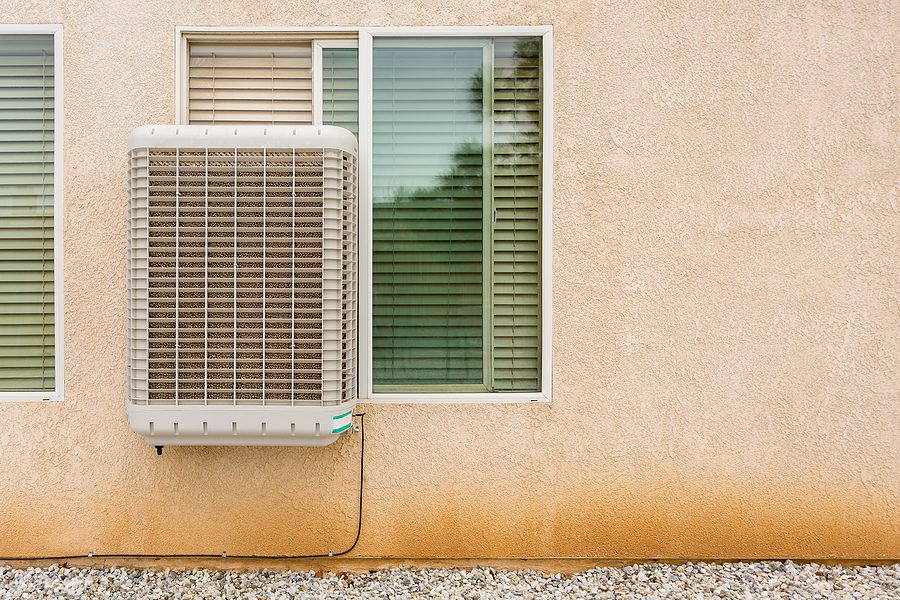
 Calcium and hard-water buildup in a swamp cooler should be removed during maintenance by first shutting the system down safely, identifying where the scale has accumulated, and cleaning only the components that can be serviced according to the cooler manufacturer’s instructions. Loose mineral deposits may be removable from the reservoir and accessible water-distribution components, while heavily scaled or deteriorated cooling pads may need replacement instead of aggressive cleaning. The correct cleaner and procedure depend on the cooler and the materials used in its components.
That distinction is especially important for Albuquerque homeowners.
Swamp coolers rely on water every time they operate. Day & Night Plumbing, Heating & Cooling’s editorial standards specifically identify hard water, mineral buildup, evaporative cooling, Albuquerque’s high-desert conditions, and seasonal HVAC maintenance as local issues that should be addressed when discussing these systems.
The white, crusty material you see on cooling pads, the reservoir, tubing, or water-distribution components is often mineral scale left behind as water evaporates.
The most important rule is simple:
Remove the Scale Without Damaging the Cooler
Not every part of a swamp cooler should be cleaned the same way.
That is why a universal recommendation such as “pour vinegar in it,” “use CLR,” or “pressure wash the pads” can be misleading. Pad materials, pumps, seals, tubing, pan coatings, floats, and metal components can differ between systems.
Why Does Calcium Build Up in a Swamp Cooler?
The basic explanation is straightforward:
Water evaporates. The dissolved minerals remain behind.
Day & Night’s company knowledge base defines hard water as water containing elevated levels of dissolved minerals, commonly calcium and magnesium.
A swamp cooler continually brings water into the evaporative cooling process. Water circulates through the system and wets the cooling media. Hot, dry air passes through the wet pads, and some of that water evaporates.
The water leaves as a vapor.
The dissolved minerals do not evaporate with it.
Over repeated cycles, those minerals can remain behind and form deposits.
Think of the process this way:
Hard water enters the cooler → water circulates → water evaporates → minerals remain → scale builds up.
That is why a swamp cooler can gradually develop a white or chalky coating even when the incoming water initially looks perfectly clear. The article worksheet specifically identifies this “water evaporates—minerals stay behind” explanation as the central concept for homeowners.
Where Does Hard-Water Buildup Form Inside a Swamp Cooler?
Cooling pads are one of the most visible locations, but mineral buildup is not limited to the pads.
Scale can develop wherever water repeatedly flows, collects, or evaporates. Depending on the cooler, that can include the reservoir or bottom pan, water-distribution passages, tubing, fittings, float-related components, and areas associated with the pump.
This is important because the location of the buildup helps determine what should happen next.
Scale on the bottom of an accessible reservoir may present a different maintenance issue than heavy deposits embedded in cooling media.
Likewise, scale around a float mechanism may have different consequences from mineral deposits restricting a water-distribution passage.
Before you start cleaning, ask:
Where exactly is the buildup?
That question is more useful than simply asking:
“What chemical dissolves calcium?”
What Does Calcium Buildup Look Like in a Swamp Cooler?
Mineral buildup often appears as a white, off-white, or chalky crust or coating on surfaces that repeatedly contact water.
You may notice deposits around the reservoir, on cooling media, near water-distribution areas, or around fittings.
But appearance alone should not be used to diagnose every substance inside the cooler.
For example, not every discoloration on a cooling pad should automatically be labeled calcium, mold, rust, or another specific material without further inspection. The article worksheet specifically cautions against diagnosing other contaminants based solely on appearance.
The practical takeaway is:
White scale is a clue—not a complete diagnosis.
Should You Turn Off a Swamp Cooler Before Cleaning It?
Yes.
Cleaning should not be performed around energized electrical components, operating motors, moving belts, rotating blowers, or energized pumps.
Day & Night’s production worksheet specifically separates minor homeowner maintenance from electrical and mechanical work and advises homeowners not to work around live electricity or moving components while cleaning.
If the work requires accessing electrical wiring, internal pump wiring, motor components, belts, or other energized equipment, that is a good point to stop and use professional service.
Rooftop access also deserves common sense. Many Albuquerque swamp coolers are mounted on roofs. If you cannot reach or work around the unit safely, the maintenance job should not become a fall hazard just to remove mineral scale.
How Do You Clean Mineral Buildup from the Swamp Cooler Reservoir?
The reservoir or pan may be one of the more practical areas for removing accessible mineral deposits during routine maintenance, provided the cooler has been safely shut down and the manufacturer’s servicing instructions allow access.
The general approach supported by the Day & Night worksheets is to remove loose deposits where appropriate, clean accessible surfaces using a method compatible with the equipment, keep inappropriate cleaners away from electrical components, and restore and test the system according to the proper procedure.
What the supplied Day & Night materials do not establish is one universal chemical formula.
They do not say that every homeowner should use a specific concentration of vinegar, commercial descaler, bleach, acid, or another chemical.
That omission is intentional.
The company knowledge base requires manufacturer recommendations to be verified when an article depends on equipment-specific instructions.
So the safe publishing rule is:
Clean the reservoir according to the cooler manufacturer’s approved maintenance procedure rather than assuming every pan coating, seal, fitting, or metal surface tolerates the same cleaner.
Can You Remove Calcium from Swamp Cooler Cooling Pads?
Sometimes light surface mineral accumulation may be serviceable, but heavily scaled pads are a different issue.
Cooling media has a specific job:
Accept water + distribute water + allow air to pass through it.
If mineral deposits interfere with those functions, the pad may no longer perform properly.
That can lead to uneven water coverage, reduced evaporation, restricted airflow, or poor cooling.
The temptation is to scrub aggressively until the pad looks clean again.
That is not always the right approach.
Some cooling-media materials can be damaged by aggressive brushing, scraping, chemicals, or high-pressure water.
The article-production worksheet therefore recommends evaluating the pad based on its material, physical condition, amount of mineral scale, water distribution, airflow, and manufacturer guidance rather than assuming every pad should simply be cleaned until the deposits disappear.
Should You Clean or Replace Mineral-Coated Swamp Cooler Pads?
If the pads are heavily scaled, physically deteriorated, restricting airflow, or no longer accepting and distributing water properly, replacement may make more sense than aggressive cleaning.
Day & Night’s company maintenance guidance specifically says to replace swamp cooler pads as needed, rather than establishing an automatic replacement schedule for every system.
A useful decision process is:
Inspect → assess condition → clean if appropriate → replace if necessary.
This is better than either extreme:
“Replace every pad whenever you see a little scale.”
or
“Never replace a pad until it physically falls apart.”
The goal is proper evaporative performance.
If water is no longer distributing well through the pad or airflow is being restricted, simply making the surface look cleaner may not restore the component’s function.
Can Calcium Buildup Clog the Swamp Cooler Water-Distribution System?
It can contribute to restricted or uneven water distribution.
That matters because the pads need adequate water coverage for evaporation to occur effectively.
The basic chain can look like this:
Mineral accumulation → restricted or uneven water distribution → partially dry cooling pads → less evaporation → poorer cooling.
Day & Night’s maintenance guidance specifically pairs cleaning mineral deposits with checking water distribution, which makes the two issues closely connected.
This can also explain why a swamp cooler may still appear to be operating while its performance declines.
The blower can run.
The pump can make noise.
Air can come from the vents.
Yet if a portion of the cooling media is not receiving enough water, the cooler may not produce the same cooling effect.
That is one reason mineral buildup can connect directly to symptoms such as a swamp cooler not blowing cold air or a swamp cooler running but not cooling the house.
Can Mineral Buildup Affect the Swamp Cooler Pump?
Mineral scale around water-handling components can potentially contribute to operational problems, but visible scale should not automatically be interpreted as proof that the pump has failed.
Day & Night’s company materials identify both scale buildup and pump failure as common evaporative-cooler issues, but the company’s diagnostic philosophy is to identify the actual underlying cause before recommending component replacement.
A cooling problem could involve the pump.
It could also involve:
- Restricted water distribution
- Worn pads
- Heavy pad scaling
- Tubing
- Another water-handling component
Replacing the pump because you see calcium elsewhere in the cooler may therefore miss the real problem.
Can Calcium Buildup Affect the Swamp Cooler Float Valve?
Mineral accumulation can potentially interfere with moving water-control components such as the float mechanism.
That can become important because the float helps control the water level inside many evaporative coolers.
If water-level control is not working properly, symptoms may include excessive filling or overflowing.
However, calcium should not be blamed automatically.
A swamp cooler that is leaking water or overflowing should be diagnosed based on the actual water source and component condition rather than assuming scale is responsible simply because deposits are visible.
This follows Day & Night’s broader editorial standard: diagnose first, then choose the appropriate maintenance, repair, or replacement.
Can You Use Vinegar to Clean a Swamp Cooler?
There is no universal vinegar recipe supported by the attached Day & Night production documents.
Some equipment owners or manufacturers may use mild descaling methods on compatible components, but whether an acidic cleaner is appropriate depends on the specific cooler and the material being cleaned.
That can include the:
pad, reservoir or pan, pump, seals, float, tubing, fittings, and metal components.
The Universal Article Variables Worksheet specifically instructs this article not to give homeowners a universal vinegar-to-water ratio. It also cautions against automatically prescribing muriatic acid, CLR, bleach, commercial descaler, acid soaking, pressure washing, or circulating chemicals through the pump without manufacturer or authoritative technical support.
So the appropriate answer is:
Check the cooler manufacturer’s maintenance instructions before putting vinegar or another acidic cleaner into the equipment.
That may be less dramatic than a one-size-fits-all internet recipe, but it is more responsible.
Should You Use CLR or a Commercial Descaler in a Swamp Cooler?
The same rule applies.
Do not assume that because a product removes calcium from one household surface it is appropriate for every evaporative-cooler component.
A commercial descaler could interact differently with:
- Metals
- Coatings
- Seals
- Plastics
- Pump components
- Cooling media
The attached production materials therefore do not universally recommend or prohibit a particular commercial cleaner. They direct product-specific cleaning decisions back to manufacturer guidance.
If a manufacturer specifically approves a product or cleaning procedure for that equipment, follow those instructions.
Approval for one cooler should not be generalized to every other brand and model.
Can You Pressure Wash Swamp Cooler Pads?
Do not assume pressure washing is safe for every cooling pad.
Some cooling media can be damaged by aggressive water pressure.
The worksheet specifically cautions against universally recommending pressure washing, scraping fragile pad material, wire brushing, or acid soaking.
This creates an important distinction:
A rugged reservoir surface and delicate evaporative cooling media are not the same cleaning job.
When the pads are badly scaled, replacement may be preferable to trying increasingly aggressive cleaning methods.
How Can You Reduce Future Hard-Water Buildup?
Mineral buildup cannot necessarily be eliminated permanently because the water itself contains dissolved minerals.
The more useful goal is to reduce accumulation and prevent deposits from being ignored until they interfere with operation.
Day & Night’s company maintenance guidance recommends inspecting and replacing pads as needed, inspecting belts and pumps, cleaning mineral deposits, checking water distribution, winterizing properly, starting the system before the hottest weather, and inspecting roof penetrations and supply lines.
For the homeowner, that means incorporating mineral scale into regular swamp-cooler maintenance instead of treating it as something to address only when the system completely stops working.
A swamp cooler can continue operating while efficiency declines or hidden wear develops. Day & Night’s knowledge base specifically notes that maintenance may reveal problems before failure.
That makes an important distinction:
The cooler does not have to stop running before mineral buildup becomes worth addressing.
Does Albuquerque Hard Water Make Swamp Cooler Maintenance More Important?
It makes mineral buildup an especially relevant maintenance consideration.
Day & Night’s editorial profile requires its Albuquerque HVAC information to reflect actual local conditions, including hard water, mineral buildup, evaporative cooling, high-desert weather, summer heat, and seasonal HVAC maintenance.
That is especially relevant to a water-based cooling system.
An evaporative cooler repeatedly moves and evaporates water throughout Albuquerque’s cooling season. If minerals accumulate in pads and water-distribution areas, they can potentially interfere with the very processes the cooler depends on.
This does not mean every Albuquerque cooler develops identical scale at the same rate.
Maintenance needs may vary with the equipment, water conditions, pad type, operating history, and previous maintenance.
That is also why a rigid statement such as:
“Every Albuquerque swamp cooler must be descaled every 90 days”
would not be supported by the Day & Night production materials.
Instead, scale should be inspected and addressed according to condition.
If you are deciding when maintenance should be performed, the related guide How Often Should a Swamp Cooler Be Serviced in Albuquerque? provides the broader seasonal-maintenance framework.
When Is Mineral Buildup Too Severe for DIY Cleaning?
Mineral scale may have progressed beyond practical homeowner cleaning when the problem involves heavily deteriorated cooling pads, restricted water distribution, pump concerns, repeated overflowing, significant deterioration or corrosion, hard-to-access internal components, electrical components, or recurring buildup accompanied by poor cooling.
Another useful clue is whether you can clearly identify what you are actually cleaning.
If scale is sitting on an accessible reservoir surface, the maintenance problem may be relatively obvious.
If water is no longer reaching part of the pads and you cannot determine whether the problem is the pump, tubing, distribution system, mineral restriction, or another component, the job has changed from simple cleaning to diagnosis.
The same applies if the cooler is leaking.
Mineral buildup can be one contributing factor when scale affects floats, fittings, drains, or water-distribution components, but the leak itself should be diagnosed before calcium is assumed to be the cause.
When Should You Call for Professional Swamp Cooler Maintenance?
Consider professional swamp cooler service when mineral buildup is no longer simply a visible housekeeping issue and begins affecting how the system operates.
Examples include poor or uneven pad saturation, reduced cooling, repeated leaking or overflowing, restricted water distribution, suspected pump problems, deteriorated cooling pads, significant scale in hard-to-access areas, or maintenance that would require work around electrical or moving mechanical components.
Day & Night Plumbing, Heating & Cooling provides swamp cooler repair, replacement, installation, evaporative cooler conversion, thermostat service, and cooling-system diagnosis as part of its Albuquerque cooling services.
The company’s approach is also relevant to mineral problems because it emphasizes visual inspection, system testing, identification of the underlying cause, explanation of repair options, customer authorization, and final testing rather than automatically replacing equipment.
Frequently Asked Questions About Calcium Buildup in Swamp Coolers
How Do You Remove Calcium and Hard-Water Buildup from a Swamp Cooler?
Shut the system down safely, identify where the scale has accumulated, and clean only components that can be serviced according to the manufacturer’s instructions. Accessible mineral deposits may be cleanable, while heavily scaled or deteriorated cooling pads may need replacement. The correct cleaner depends on the particular equipment and materials.
What Causes the White Buildup Inside a Swamp Cooler?
Hard water contains dissolved minerals, commonly including calcium and magnesium. Water evaporates during swamp-cooler operation, but the minerals can remain behind and gradually accumulate as scale.
Can You Clean Calcium from Swamp Cooler Pads?
It depends on the pad material and condition. Minor buildup may be serviceable according to manufacturer guidance, while heavily scaled, deteriorated, airflow-restricting, or poorly wetting pads may be better replaced.
Should Mineral-Coated Swamp Cooler Pads Be Replaced?
Not automatically. Day & Night’s maintenance guidance is to replace pads as needed. Pad condition, amount of scale, water distribution, airflow, material, and manufacturer recommendations should guide the decision.
Can You Use Vinegar in a Swamp Cooler?
Do not assume one vinegar mixture is appropriate for every cooler. Whether an acidic cleaner is suitable depends on the specific equipment and component materials. Check the manufacturer’s maintenance instructions before introducing vinegar or another descaling product.
Can You Use CLR in a Swamp Cooler?
The supplied Day & Night materials do not universally recommend CLR or another commercial descaler. Use a cleaner only when it is approved or appropriate for the particular cooler and component being serviced.
Can Mineral Buildup Stop Water from Reaching Swamp Cooler Pads?
Mineral accumulation can contribute to restricted or uneven water distribution. If part of the pad remains dry, evaporation and cooling performance can decline. Day & Night’s maintenance guidance specifically recommends cleaning mineral deposits and checking water distribution.
Can Hard Water Damage a Swamp Cooler?
Hard-water mineral buildup can become a maintenance concern in evaporative coolers and may affect pads and water-handling components. Day & Night specifically identifies scale buildup in evaporative coolers as a common cooling-system problem.
Can Mineral Buildup Make a Swamp Cooler Leak?
It may be one contributing factor if scale interferes with water-control or distribution components, but a leak should be diagnosed rather than automatically blamed on mineral buildup.
How Can I Keep Calcium from Coming Back?
Regular inspection, mineral-deposit cleaning when appropriate, water-distribution checks, pump and component maintenance, seasonal service, and pad replacement as needed can help manage recurring buildup. The production materials do not promise that mineral scale can be eliminated permanently.
Swamp Cooler Hard-Water Maintenance in Albuquerque
Calcium and hard-water buildup are not just cosmetic when they begin affecting water distribution, pad condition, airflow, or cooling performance.
The most useful maintenance sequence is:
Identify where the scale is → determine what component is affected → clean only when the component and manufacturer guidance allow it → replace deteriorated components when appropriate → diagnose any continuing cooling, leaking, or water-distribution problem.
If your swamp cooler has heavy calcium buildup, crusted cooling pads, uneven water distribution, reduced cooling, recurring leaks, or mineral scale in components you cannot safely service, contact Day & Night Plumbing, Heating & Cooling for professional evaluation.
Call Day & Night Plumbing, Heating & Cooling at (505) 974-5797 to schedule swamp cooler maintenance or repair in Albuquerque and Central New Mexico. The company is based at 2100 Aztec Rd. NE, Suite A, Albuquerque, New Mexico 87107.