There’s nothing more frustrating than walking into your home on a hot Albuquerque afternoon, lowering the thermostat, hearing your air conditioner turn on—and then realizing the house isn’t getting any cooler.
If your air conditioner is running but not cooling your home, you’re certainly not alone. This is one of the most common reasons homeowners call for HVAC service during New Mexico’s long, hot summers. Sometimes the solution is surprisingly simple, such as replacing a dirty air filter or adjusting the thermostat. In other cases, the problem may involve a frozen evaporator coil, low refrigerant, dirty condenser coils, electrical component failure, or another issue that requires professional diagnosis.
The good news is that an air conditioner that isn’t cooling doesn’t automatically mean you’ll need to replace the entire system. Many cooling problems can be corrected quickly when they’re identified early. Waiting too long, however, can lead to higher energy bills, reduced comfort, unnecessary wear on your equipment, and potentially more expensive repairs.
In this guide, you’ll learn how your air conditioning system cools your home, the most common reasons an AC stops cooling properly, which troubleshooting steps homeowners can safely perform, and when it’s time to call an experienced HVAC technician. We’ll also explain how Albuquerque’s high-desert climate affects air conditioning performance and share preventative maintenance tips that can help keep your system operating efficiently throughout the cooling season.
How an Air Conditioner Cools Your Home
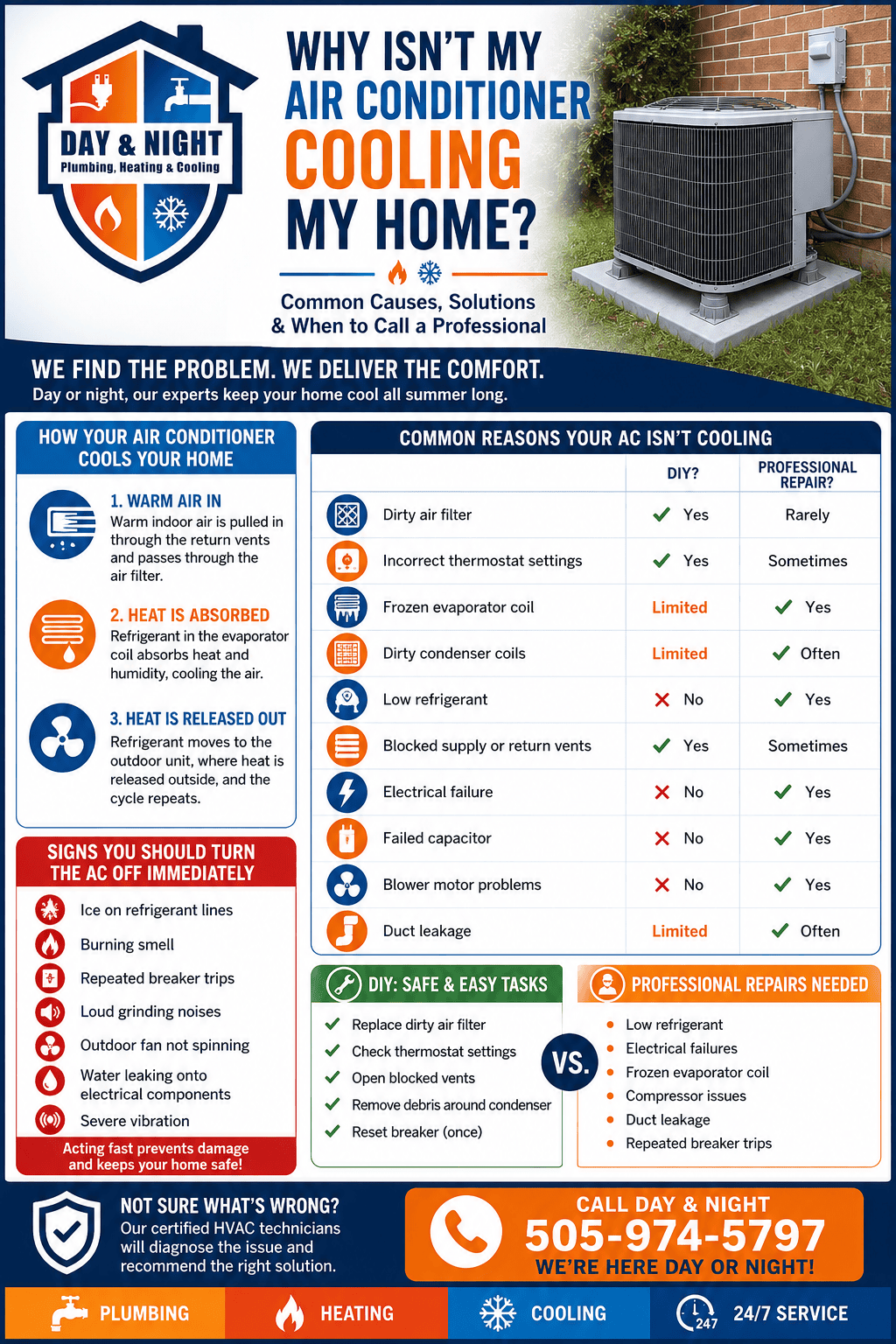
Understanding how your air conditioner works makes it much easier to understand why it may stop cooling effectively.
Although it feels like your air conditioner creates cold air, that’s not actually what’s happening.
Instead, your cooling system removes heat from inside your home and transfers it outdoors through a continuous refrigeration cycle.
Here’s a simplified explanation of the process:
Step 1: Warm Indoor Air Is Pulled Into the System
Your home’s blower fan draws warm indoor air through the return vents and across the evaporator coil inside the air handler or furnace.
Before reaching the evaporator coil, the air passes through the HVAC air filter, which removes dust, pollen, pet dander, and other airborne particles.
Step 2: Heat Is Absorbed by the Refrigerant
Inside the evaporator coil is refrigerant that absorbs heat from the indoor air.
As the refrigerant absorbs heat:
- The air becomes cooler.
- Excess humidity condenses into water.
- The cooled air is circulated back through your home’s ductwork.
The condensation produced during this process drains safely through the condensate drain system.
Step 3: Heat Is Released Outdoors
The warmed refrigerant travels to the outdoor condenser unit.
There, the condenser fan blows outdoor air across the condenser coils, allowing the refrigerant to release the heat it collected from inside your home.
Once the heat has been released, the refrigerant returns indoors to repeat the cycle.
This process continues until your thermostat senses that the desired indoor temperature has been reached.
Why An Air Conditioner Can Run Without Cooling
One of the most confusing HVAC problems homeowners experiences is an air conditioner that appears to be working normally but never cools the house.
You may notice:
- The outdoor condenser is running.
- The indoor blower is operating.
- Air is coming from the vents.
- The thermostat appears normal.
Yet your home’s temperature barely changes.
This happens because an air conditioner depends on several different systems working together.
If any one of these components stops functioning correctly, the system may continue running without producing enough cooling.
Some of the most common causes include:
- Dirty air filters
- Thermostat settings or malfunctions
- Frozen evaporator coils
- Dirty outdoor condenser coils
- Low refrigerant
- Blocked airflow
- Failing capacitors
- Electrical component failures
- Blower motor problems
- Duct leakage
- Compressor issues
Some of these problems reduce efficiency gradually, while others can cause cooling performance to drop dramatically almost overnight.
The sooner the underlying issue is identified, the more likely it can be repaired before additional components are damaged.
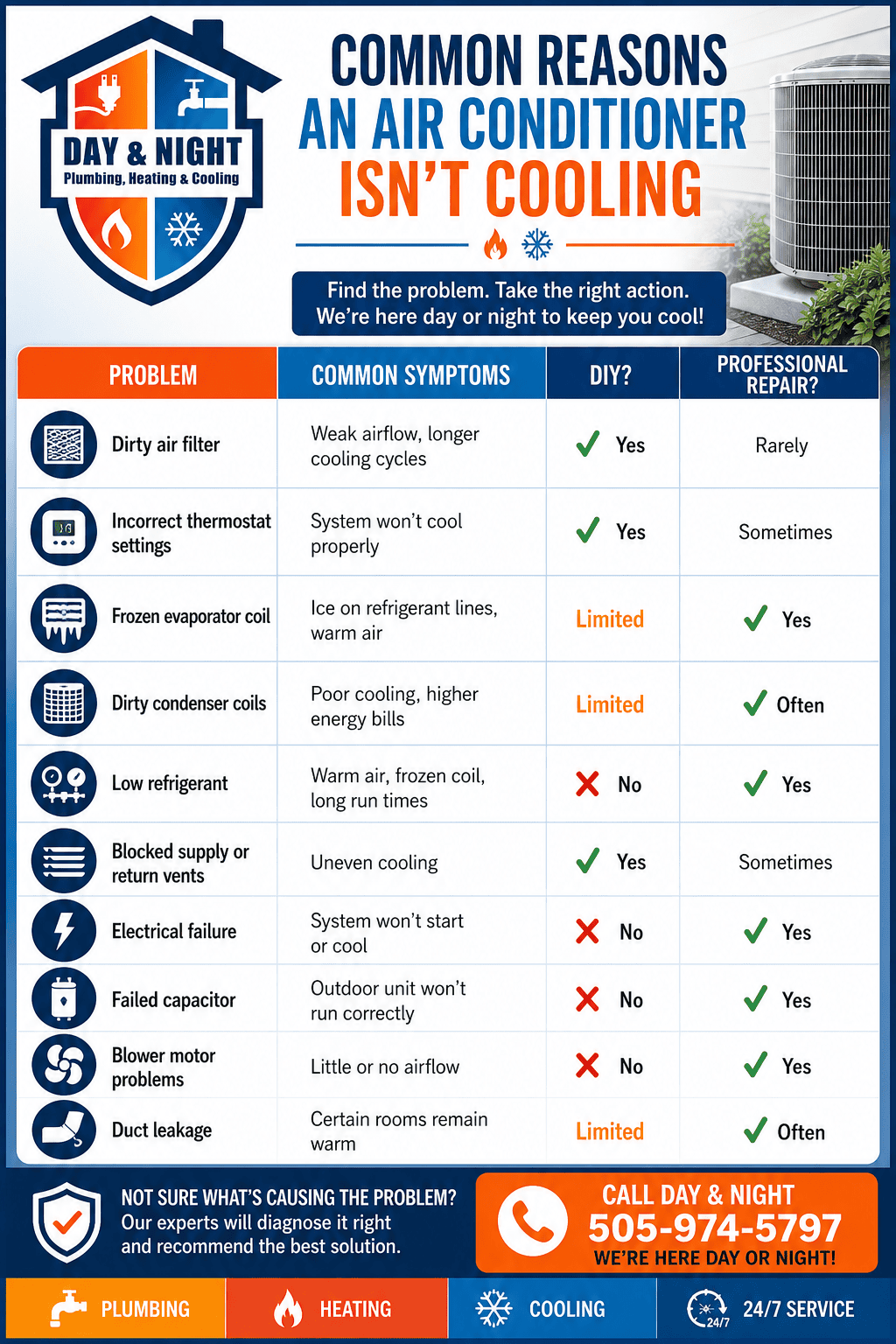
As you can see, some cooling problems are simple maintenance issues that homeowners can address themselves, while others require specialized equipment and professional expertise. Knowing the difference can help you avoid unnecessary repairs and keep your system operating safely.
Dirty Air Filter
One of the most common—and fortunately one of the easiest to fix—reasons an air conditioner isn’t cooling properly is a dirty air filter.
Your HVAC filter plays an important role in protecting your equipment. As air circulates through your home, the filter captures airborne contaminants such as:
- Dust
- Dirt
- Pollen
- Pet hair
- Lint
- Mold spores
- Other airborne debris
Over time, these particles accumulate within the filter. As the filter becomes clogged, it restricts the amount of air flowing through your HVAC system.
Reduced airflow creates several problems at once. The evaporator coil receives less warm air to absorb heat from, your blower has to work harder to move air through the system, and cooling efficiency begins to decline. Homeowners often first notice that the air conditioner seems to run continuously while the indoor temperature changes very little.
Fortunately, this is also one of the easiest issues to prevent. Regularly inspecting and replacing your air filter helps maintain proper airflow, improves energy efficiency, and reduces unnecessary strain on your cooling system. It is also an important part of the preventative maintenance approach emphasized by Day & Night Plumbing, Heating & Cooling, whose technicians focus on identifying small issues before they become costly repairs.
Complete Dirty Air Filter Section
As the air filter continues to collect dust and debris, the restricted airflow can eventually cause the evaporator coil to become too cold. In some cases, moisture on the coil freezes into ice, creating another common cooling problem that further reduces your system’s ability to cool your home.
Additional signs of a clogged air filter include:
- Weak airflow from supply vents
- Rooms cooling unevenly
- Longer cooling cycles
- Higher utility bills
- Increased indoor dust
- The air conditioner running almost continuously
- Ice forming on refrigerant lines
- Reduced overall comfort
Fortunately, checking your air filter is one of the easiest maintenance tasks homeowners can perform.
Locate the filter near the return air duct, furnace, or air handler. Hold it up to a light source. If very little light passes through the filter or it’s visibly coated with dust and debris, it’s time for a replacement.
Most standard one-inch filters should be inspected monthly during Albuquerque’s cooling season and replaced every one to three months, depending on household conditions. Homes with pets, smokers, construction dust, or allergy sufferers often require more frequent replacement.
Replacing a dirty air filter is inexpensive and often restores airflow before more serious problems develop.
Thermostat Problems
Sometimes the issue isn’t your air conditioner at all—it’s the thermostat controlling it.
Because the thermostat tells your HVAC system when to start and stop cooling, incorrect settings or thermostat malfunctions can make it appear that your air conditioner has failed when the equipment itself is functioning normally.
Before assuming you need HVAC repairs, verify the following:
- Thermostat is set to Cool
- Desired temperature is below the current room temperature
- Fan is set to Auto instead of On
- Batteries (if applicable) are not depleted
- Screen is functioning properly
- Program schedules haven’t accidentally changed
Smart thermostats can occasionally lose programming after power outages or software updates. Likewise, older mechanical thermostats may become inaccurate over time.
A poorly located thermostat can also affect cooling performance. If it’s installed near direct sunlight, kitchen appliances, or other heat sources, it may detect temperatures that don’t accurately represent the rest of the home.
If your thermostat appears to be functioning correctly but the house still won’t cool, the problem likely lies elsewhere within the HVAC system.
Frozen Evaporator Coil
A frozen evaporator coil is another common reason an air conditioner continues running without adequately cooling your home.
Many homeowners are surprised to learn that ice forming inside an air conditioner actually prevents it from producing cold air.
The evaporator coil depends on warm indoor air constantly moving across its surface. When airflow becomes restricted or refrigerant levels become too low, the coil temperature can drop below freezing.
As humidity freezes onto the coil, additional ice continues accumulating until airflow is nearly blocked.
Common causes include:
- Dirty air filters
- Blocked return vents
- Closed supply registers
- Low refrigerant
- Blower motor problems
- Dirty evaporator coils
Signs of a frozen evaporator coil include:
- Ice on refrigerant lines
- Warm air from supply vents
- Reduced airflow
- Water leaking after the ice melts
- AC running continuously
If you notice ice anywhere on the indoor refrigerant lines or evaporator coil, turn the system off immediately and allow it to thaw.
Continuing to operate a frozen system can place unnecessary stress on the compressor—one of the most expensive components in your air conditioning system.
After thawing, professional diagnosis is recommended to determine what caused the freezing in the first place.
Dirty Condenser Coils
While the evaporator coil removes heat inside your home, the outdoor condenser coil releases that heat into the outside air.
If the condenser becomes coated with:
- Dirt
- Cottonwood
- Dust
- Grass clippings
- Leaves
- Pollen
- Wind-blown debris
its ability to release heat is significantly reduced.
As a result:
- Cooling efficiency drops.
- Energy consumption increases.
- Cooling cycles become longer.
- Indoor temperatures rise.
- Compressor strain increases.
This problem is particularly common in Albuquerque, where windblown dust and pollen frequently accumulate on outdoor equipment.
Homeowners should keep vegetation trimmed back and remove obvious debris from around the outdoor condenser. However, cleaning condenser coils often requires specialized equipment and proper techniques to avoid bending delicate aluminum fins.
Professional preventative maintenance typically includes safely cleaning condenser coils to restore proper heat transfer and maximize cooling efficiency.
Low Refrigerant
Unlike motor oil in a vehicle, refrigerant is not consumed during normal operation.
A properly functioning air conditioning system should never “use up” refrigerant.
If refrigerant levels become low, there’s almost always a leak somewhere within the sealed refrigeration system.
Low refrigerant can cause:
- Reduced cooling capacity
- Frozen evaporator coils
- Longer cooling cycles
- Higher utility bills
- Warm air from vents
- Compressor damage if left untreated
Because refrigerant systems operate under high pressure and federal regulations govern refrigerant handling, homeowners should never attempt to recharge refrigerant themselves.
Professional HVAC technicians use specialized equipment to:
- Locate refrigerant leaks
- Repair the leak
- Evacuate the system
- Recharge refrigerant to manufacturer specifications
- Verify proper system operation
Simply adding refrigerant without repairing the leak only provides a temporary solution.
Airflow Restrictions
Your air conditioner depends on unrestricted airflow throughout the entire HVAC system.
Even if the refrigeration system is functioning perfectly, poor airflow can dramatically reduce cooling performance.
Common airflow restrictions include:
- Dirty air filters
- Closed supply registers
- Blocked return air vents
- Furniture covering vents
- Crushed or disconnected ductwork
- Dirty evaporator coils
- Failing blower motors
Walk through your home periodically to ensure furniture, rugs, curtains, and other objects aren’t blocking vents.
Although closing vents in unused rooms may seem like a good way to save energy, doing so can actually reduce airflow, increase system pressure, and make your HVAC system work harder.
Maintaining balanced airflow throughout the home helps maximize both comfort and system efficiency.
Electrical Component Failures
Modern air conditioning systems rely on numerous electrical components working together.
If even one component begins to fail, cooling performance may suffer.
Examples include:
- Capacitors
- Contactors
- Relays
- Control boards
- Blower motors
- Condenser fan motors
- Wiring connections
- Safety switches
Electrical problems may produce symptoms such as:
- Outdoor unit not starting
- System repeatedly cycling on and off
- Buzzing or humming sounds
- Warm air
- Intermittent cooling
- Breakers tripping repeatedly
Because electrical diagnosis involves energized equipment and specialized testing instruments, these repairs should always be performed by qualified HVAC technicians.
Day & Night Plumbing, Heating & Cooling emphasizes a diagnosis-first approach, carefully identifying the underlying cause of HVAC problems before recommending repairs. This helps homeowners receive accurate recommendations and long-term solutions rather than temporary fixes.
How Albuquerque’s Climate Affects Air Conditioning Performance
Air conditioning systems in Albuquerque operate under conditions that differ from many other parts of the country. The city’s high-desert environment brings long periods of intense summer sunshine, low humidity, blowing dust, and daytime temperatures that frequently climb into the 90s or higher. These conditions place significant demands on residential cooling systems.
Dust and airborne debris can clog air filters and coat outdoor condenser coils more quickly than in many other climates. During periods of heavy wind, dirt and pollen may accumulate around outdoor units, reducing their ability to release heat efficiently.
Many Albuquerque homes also experience extended cooling seasons, meaning air conditioners often operate for long hours during the summer. Without regular maintenance, components such as air filters, blower motors, condensate drains, and coils experience additional wear.
Annual preventative maintenance helps prepare your cooling system for these demanding conditions by improving airflow, cleaning critical components, identifying developing problems early, and helping your equipment operate as efficiently and reliably as possible throughout the hottest months of the year.
DIY vs. Professional Repairs
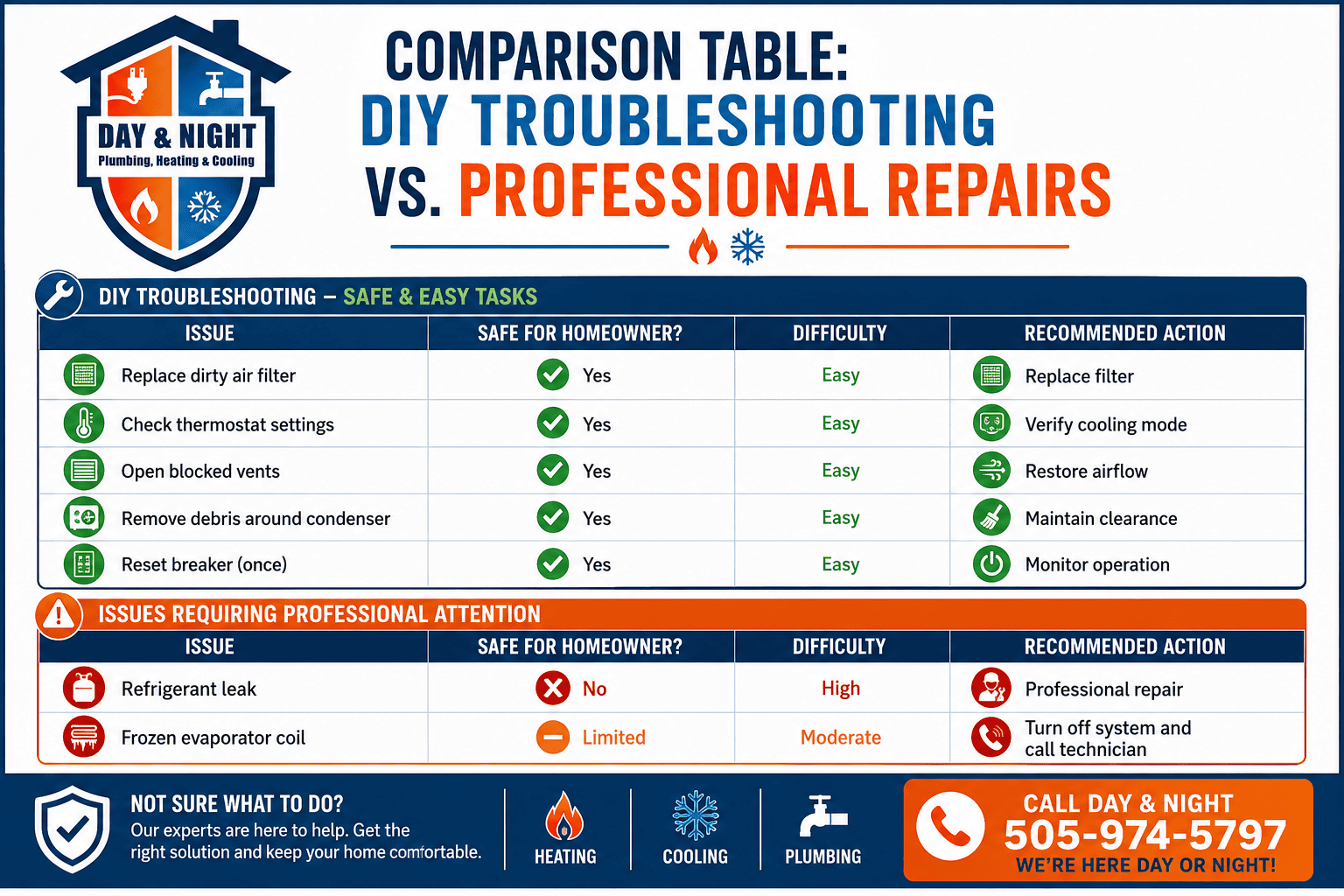
When your air conditioner isn’t cooling your home, it’s natural to want to solve the problem yourself. Fortunately, there are several simple maintenance items homeowners can safely check before scheduling service. However, many air conditioning problems involve electrical components, refrigerant, or specialized diagnostic equipment that should only be handled by trained HVAC technicians.
Knowing where DIY troubleshooting ends and professional repair begins can help you avoid unnecessary damage while restoring your home’s comfort more quickly.
Safe DIY Troubleshooting
Homeowners can safely perform the following basic checks:
- Verify the thermostat is set to Cool and the temperature is below the current room temperature.
- Replace or clean a dirty HVAC air filter.
- Check that all supply and return vents are open and unobstructed.
- Make sure the outdoor condenser has adequate clearance from weeds, shrubs, or debris.
- Inspect the circuit breaker if the system won’t start.
- Remove leaves, cottonwood, or other loose debris from around the outdoor unit.
- Listen for unusual sounds that may help describe the problem to your HVAC technician.
These simple steps often resolve minor airflow problems or help identify the source of the issue before professional service is needed.
Problems That Require Professional Repair
Certain repairs should always be left to experienced HVAC professionals because they involve specialized tools, electrical hazards, or regulated refrigerants.
Professional diagnosis is recommended for:
- Refrigerant leaks
- Frozen evaporator coils that repeatedly return
- Compressor problems
- Electrical failures
- Capacitor replacement
- Contactor replacement
- Blower motor failures
- Condenser fan motor issues
- Refrigerant charging
- Control board failures
- Persistent thermostat problems
- Ductwork repairs
Day & Night Plumbing, Heating & Cooling follows a diagnosis-first approach, carefully evaluating the root cause of the problem before recommending repairs. This allows homeowners to make informed decisions based on accurate information rather than guesswork.
Homeowner Air Conditioner Troubleshooting Checklist
Before calling for service, work through this simple checklist.
Step 1
Verify your thermostat:
- Set to Cool
- Fan on Auto
- Temperature set below room temperature
Step 2
Inspect the HVAC air filter.
If it’s dirty, replace it with the proper size and rating.
Step 3
Check every supply register and return vent.
Remove any furniture, rugs, boxes, or curtains blocking airflow.
Step 4
Look outside.
Make sure the outdoor condenser is free of:
- Leaves
- Dirt buildup
- Weeds
- Grass clippings
- Cottonwood
- Windblown debris
Step 5
Check your electrical panel.
Reset a tripped breaker one time if appropriate.
If it trips again, discontinue use and call a professional.
Step 6
Inspect for ice.
If you see ice on refrigerant lines or the indoor evaporator coil:
- Turn the system off.
- Allow it to thaw.
- Schedule professional service.
Step 7
Pay attention to unusual symptoms.
Examples include:
- Buzzing
- Grinding
- Squealing
- Burning odors
- Water leaks
- Short cycling
- Warm air
Providing these observations helps your technician diagnose the issue more efficiently.
When to Turn Your Air Conditioner Off
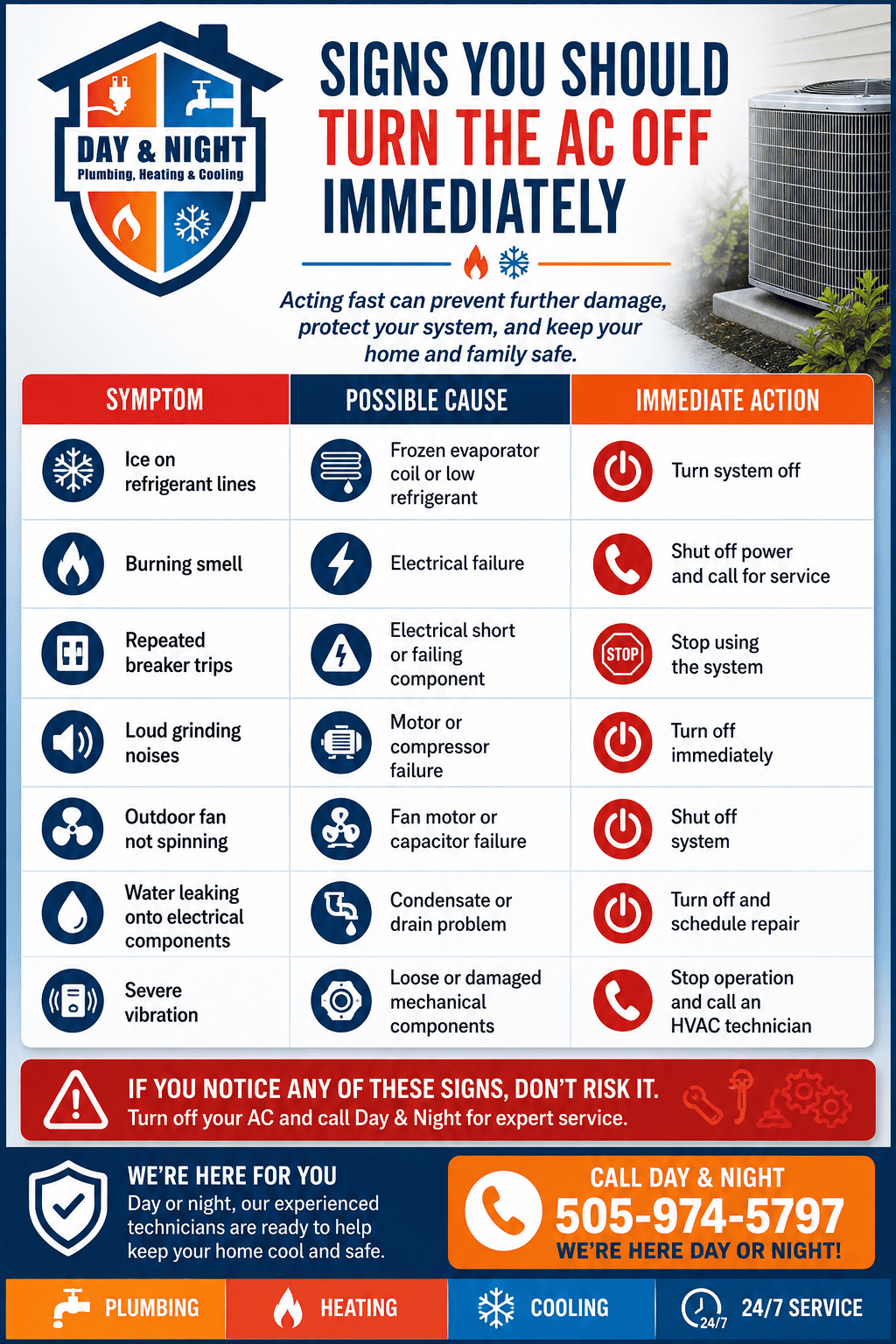
Although many cooling problems allow the system to continue operating temporarily, some situations require shutting it down immediately to prevent additional damage.
Turn your air conditioner off if you notice:
- Ice on refrigerant lines
- Ice covering the evaporator coil
- Burning electrical odors
- Smoke
- Repeated breaker trips
- Loud grinding or metal-on-metal noises
- Water leaking around electrical components
- Outdoor fan not operating while the compressor continues running
- Severe vibration
Operating an air conditioner under these conditions may damage expensive components, particularly the compressor.
When in doubt, it’s generally safer to turn the system off and schedule professional diagnosis.
Should You Repair or Replace Your Air Conditioner?
Not every cooling problem means your system needs to be replaced.
Many issues—including dirty air filters, clogged condensate drains, thermostat problems, and capacitor failures—are relatively straightforward repairs that can restore normal operation.
Replacement becomes a more practical consideration when:
- The system is 15–20 years old or older.
- Repairs are becoming increasingly frequent.
- Energy bills continue rising despite maintenance.
- Major components such as the compressor have failed.
- Refrigerant leaks are extensive or recurring.
- The system no longer cools your home evenly.
A professional inspection helps determine whether repairing your existing equipment or investing in a new, energy-efficient system provides the better long-term value.
Rather than recommending replacement automatically, experienced HVAC technicians evaluate the condition of the entire system, expected remaining service life, repair costs, operating efficiency, and your long-term comfort goals before making recommendations.
Preventative Maintenance Helps Prevent Cooling Problems
The majority of summertime air conditioning failures don’t occur without warning.
Many develop gradually over months or even years as dirt accumulates, components wear, and airflow becomes restricted.
Routine preventative maintenance helps identify these developing issues before they lead to inconvenient breakdowns during Albuquerque’s hottest weather.
Professional maintenance typically includes:
- Replacing or inspecting air filters
- Cleaning evaporator coils
- Cleaning condenser coils
- Inspecting refrigerant pressures
- Testing electrical components
- Tightening electrical connections
- Inspecting capacitors
- Checking blower operation
- Flushing condensate drains
- Verifying thermostat calibration
- Measuring system airflow
- Testing overall cooling performance
Preventative maintenance offers several important benefits:
- Improved energy efficiency
- Lower utility bills
- More reliable cooling
- Longer equipment life
- Fewer emergency repairs
- Better indoor comfort
- Early identification of worn components
For homeowners in Albuquerque, where long cooling seasons, blowing dust, and high summer temperatures place added stress on HVAC equipment, annual maintenance is one of the best investments you can make in your home’s comfort and the long-term performance of your air conditioning system. This focus on preventative maintenance aligns with the company’s emphasis on dependable workmanship, long-term solutions, and helping customers avoid costly breakdowns.
Frequently Asked Questions
Why is my air conditioner running but not cooling my home?
The most common reasons include a dirty air filter, thermostat problems, frozen evaporator coils, dirty condenser coils, low refrigerant, airflow restrictions, or electrical component failures. While homeowners can safely inspect items such as the thermostat and air filter, persistent cooling problems should be professionally diagnosed to prevent additional damage.
Why is my AC blowing warm air?
Warm air can be caused by an incorrect thermostat setting, restricted airflow, a frozen evaporator coil, low refrigerant, a malfunctioning compressor, or an electrical issue. Because several different problems can produce the same symptom, professional testing is often needed to determine the exact cause.
Can a dirty air filter really stop my AC from cooling?
Yes. A severely clogged air filter restricts airflow across the evaporator coil, reducing the system’s ability to remove heat from your home. In some cases, restricted airflow can even cause the evaporator coil to freeze, making cooling even less effective.
How do I know if my air conditioner is low on refrigerant?
Common signs include warm air from the vents, ice on refrigerant lines, unusually long cooling cycles, higher utility bills, and reduced cooling capacity. Refrigerant should never need routine “topping off.” If levels are low, the system likely has a leak that should be located and repaired by a qualified HVAC technician.
Should I turn my AC off if I see ice on it?
Yes. Ice on the refrigerant lines or evaporator coil usually indicates an airflow problem or refrigerant issue. Continuing to operate the system may damage the compressor. Turn the system off, allow it to thaw, and schedule professional service.
Can Albuquerque’s climate make my air conditioner work harder?
Absolutely. Albuquerque’s high-desert environment exposes HVAC systems to prolonged summer heat, blowing dust, pollen, and long cooling seasons. These conditions can cause air filters and outdoor condenser coils to become dirty more quickly, making regular maintenance especially important for efficient system performance.
How often should my air conditioner be professionally serviced?
Most manufacturers and HVAC professionals recommend scheduling preventative maintenance once each year, ideally during the spring before heavy summer use begins. Annual inspections help identify worn components, improve efficiency, and reduce the likelihood of unexpected breakdowns during peak cooling season.
Is it better to repair or replace my air conditioner?
That depends on several factors, including the age of the system, repair costs, energy efficiency, and the condition of major components. Many cooling problems can be repaired economically, while older systems with frequent breakdowns or major compressor failures may be better candidates for replacement. A professional inspection can help you determine the most cost-effective long-term solution.
Conclusion
An air conditioner that isn’t cooling your home doesn’t always mean the system has reached the end of its life. In many cases, the problem can be traced to something as simple as a dirty air filter, thermostat issue, or blocked airflow. Other situations, such as frozen evaporator coils, refrigerant leaks, electrical failures, or compressor problems, require professional diagnosis and repair.
The key is to address cooling problems promptly. Continuing to operate an underperforming system can increase energy consumption, place unnecessary strain on expensive components, and lead to more extensive repairs over time.
Routine preventative maintenance remains one of the best ways to keep your air conditioner operating efficiently, especially in Albuquerque’s demanding climate. Regular inspections, cleaning, and professional tune-ups help maximize performance, extend equipment life, and reduce the likelihood of unexpected breakdowns during the hottest months of the year.
If your air conditioner is running but your home still isn’t staying comfortable, an experienced HVAC technician can identify the underlying cause and recommend the most effective solution.
Contact Day & Night Plumbing, Heating & Cooling Today
When your air conditioner stops keeping your home cool, you need fast, dependable service from professionals who understand Albuquerque’s unique climate and cooling challenges. The experienced technicians at Day & Night Plumbing, Heating & Cooling provide comprehensive air conditioning diagnostics, repairs, preventative maintenance, and system replacements for homeowners throughout Albuquerque and Central New Mexico.
Whether your system has a clogged air filter, frozen evaporator coil, refrigerant leak, electrical problem, airflow restriction, or another cooling issue, our team takes the time to accurately diagnose the problem before recommending the right solution. We believe in honest recommendations, dependable workmanship, and long-term repairs that help restore your home’s comfort and energy efficiency.
Don’t spend another day struggling with an air conditioner that can’t keep up with New Mexico’s summer heat. Contact Day & Night Plumbing, Heating & Cooling today to schedule professional air conditioning service and let our experienced technicians help keep your home comfortable all season long.