
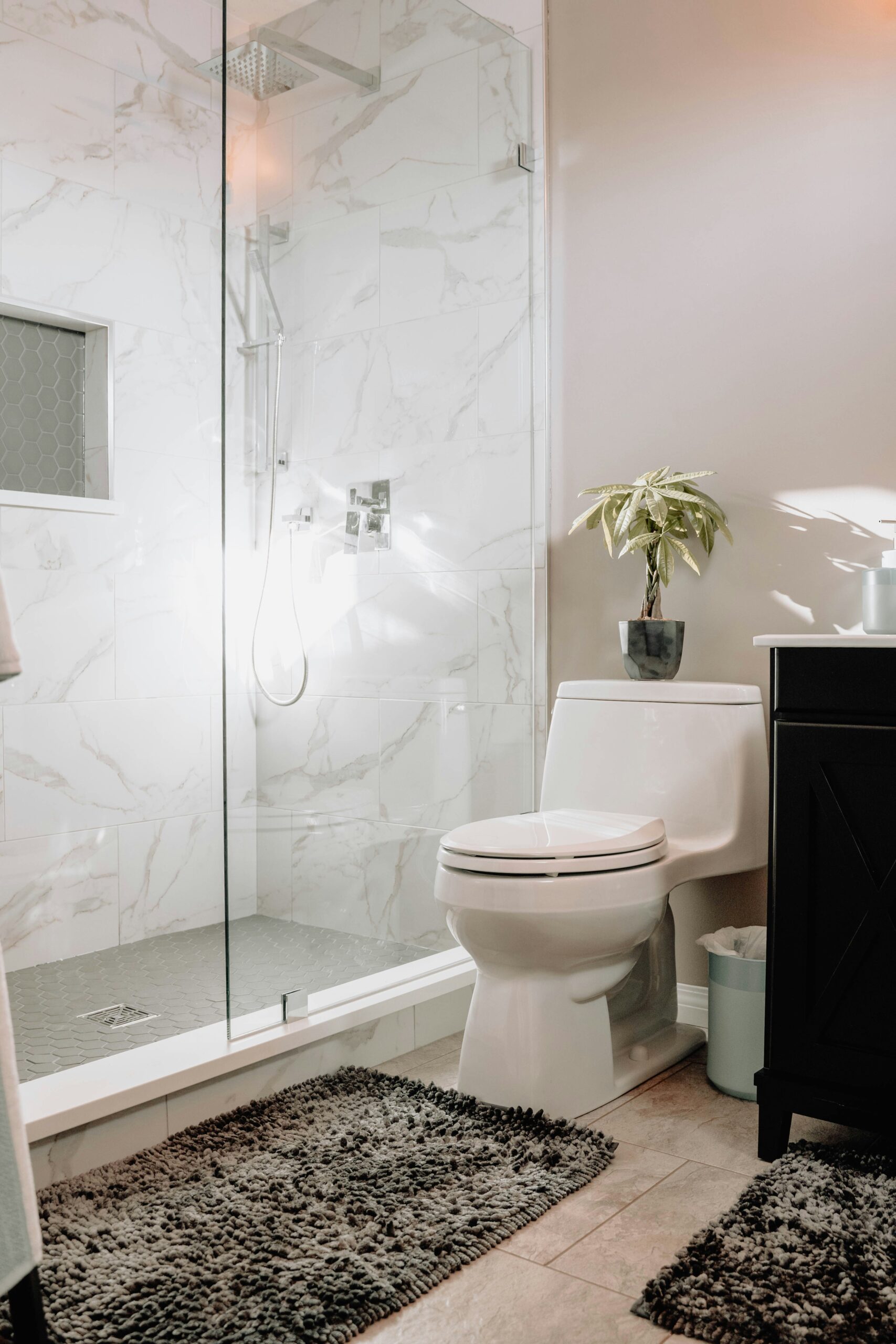
 Water around the base of a toilet does not automatically mean the wax ring or toilet seal has failed. The water may actually be coming from higher up—from the supply line, shutoff valve, toilet tank, or tank-to-bowl connection—and running down the outside of the toilet before collecting on the floor. Condensation or water from another bathroom fixture can create a similar puddle.
One of the best clues is when the water appears.
If the floor stays dry while the toilet sits unused but water repeatedly appears from beneath the toilet during or immediately after flushing, the toilet-to-drain seal or flange area becomes more suspicious. If moisture returns even when nobody has flushed the toilet, look more closely at the pressurized water supply, shutoff valve, tank, condensation, or another nearby source.
If water is actually coming from beneath the toilet, stop using it until the source can be identified and repaired. Continuing to flush can send additional water—and potentially wastewater—into flooring and the subfloor below.
Homeowners Want to Know Why Is My Toilet Leaking Around the Base
There are several possible reasons water can collect around the bottom of a toilet.
The toilet-to-drain seal may no longer be sealing correctly. The toilet may be loose or rocking. The closet flange that connects the toilet to the drain system may be damaged or unable to hold the toilet securely.
But those aren’t the only possibilities.
A leaking toilet supply connector can drip behind the bowl. A shutoff valve can leak. Water can escape from the tank or the connection between the tank and bowl. Condensation can form on a cool toilet surface and drip onto the floor. Water from a nearby shower, bathtub, sink, or even bathroom cleaning can travel across the floor and collect along the toilet base.
That’s why where you find the puddle is not necessarily where the water started.
Before assuming the toilet needs to be removed and a new sealing ring installed, determine whether the water is truly coming from underneath it.
Is the Water Really Coming from Under the Toilet?
Start with observation rather than disassembly.
Dry the bathroom floor and the outside of the toilet completely. Pay particular attention to the supply line, shutoff valve, underside of the tank, tank-to-bowl area, sides of the bowl, and the floor immediately around the toilet.
Then watch where moisture first returns.
This simple step can prevent a common diagnostic mistake: finding water at the base and assuming the base itself must be leaking.
Dry the Floor and Trace the Highest Wet Point
Water follows gravity.
A slow drip from the tank can travel down the back or side of the toilet and end up exactly where you would expect a failed toilet seal to produce a puddle. The same thing can happen with a supply connection.
Rather than starting at the puddle, trace upward.
If the floor is wet but you also find moisture higher on the toilet, the higher wet point deserves attention first.
A dry paper towel can be useful for checking accessible exterior surfaces and connections because even a small amount of moisture becomes easy to see. This is an observation technique, not a reason to disconnect plumbing or remove the toilet.
Watch What Happens During a Flush and During Tank Refill
Timing can narrow the possibilities considerably.
After everything has been dried, observe the toilet through a normal flush and refill cycle. Watch accessible areas without removing parts.
Does water appear only when the toilet is flushed?
Does it show up while the tank is refilling?
Does the floor stay dry through the entire cycle, only for moisture to return later?
Does water appear even when the toilet hasn’t been used?
Those patterns point in different directions.
| When Water Appears | Possible Area to Check | What the Pattern May Suggest |
| During or immediately after flushing | Toilet-to-drain seal, flange or mounting area | A problem at the connection beneath the toilet becomes more plausible |
| During tank refill | Supply connector, shutoff valve, tank or tank connection | Water may be leaking from the pressurized supply side or tank |
| Continuously while toilet is unused | Supply valve, connector or another pressurized source | Probably not caused solely by the flush-to-drain seal |
| During humid conditions on cool toilet surfaces | Tank or bowl exterior | Condensation may be contributing |
| After showering, bathing or cleaning | Nearby fixture or floor surface | Water may be traveling toward the toilet rather than coming from it |
These patterns are clues, not final diagnoses.
What Does It Mean If the Toilet Leaks Only When I Flush?
A toilet that repeatedly leaks from underneath only during or shortly after flushing deserves particular attention.
During a flush, water and waste pass from the toilet into the drain connection beneath it. A sealing ring between the toilet and drain is designed to maintain that connection.
If the tank, supply connector, shutoff valve, and outside surfaces remain dry but water repeatedly appears from underneath the toilet after a flush, a problem at the toilet-to-drain connection becomes more plausible.
That still does not prove that the sealing ring is the only problem.
The Toilet-to-Drain Seal May No Longer Be Sealing Correctly
Many toilets use a wax ring to create the seal between the toilet outlet and the drain connection below. Other sealing systems are also available, so “wax ring” should not be treated as a universal description of every toilet installation.
If that seal is compromised, water can escape during flushing.
Because the leak may happen only when water moves through the drain connection, the floor can remain completely dry between flushes. That pattern is very different from a leaking supply connection, which can continue dripping while the toilet sits unused.
A flush-related leak is one reason to stop using the toilet until it can be inspected. Repeated test flushing can simply send more water into the floor.
A Loose or Rocking Toilet Can Affect the Seal
A toilet should sit securely on its mounting surface.
If it rocks, shifts, or moves when someone sits on it, that movement can place stress on the connection and sealing area beneath the fixture.
A rocking toilet is therefore an important clue—but it does not prove that the wax ring is bad.
Movement could involve the mounting hardware, flange, floor, installation, or a combination of conditions that need to be inspected.
This is also why aggressively tightening the toilet’s mounting bolts is not a good universal solution. Toilet bowls are typically made from vitreous china, and excessive tightening can damage the fixture. If the toilet moves, the reason for that movement should be identified instead of assuming the bolts simply need more force.
The Closet Flange or Mounting Surface May Need Inspection
The toilet connects to the drainage system at a component commonly called the closet flange.
The flange helps position and secure the toilet while providing the connection point between the fixture and drain system.
If the flange is damaged, loose, improperly positioned, or no longer provides a secure mounting point, simply replacing the sealing ring may not correct the underlying problem.
The condition of the floor can matter too. If water has been leaking around or beneath the toilet for some time, the mounting surface or subfloor may need to be evaluated.
That is why a plumber may need to inspect more than the sealing ring when a toilet leaks from underneath or repeatedly becomes loose.
What If Water Appears Even When the Toilet Has Not Been Flushed?
This is one of the most useful distinctions a homeowner can make.
If you dry everything and water returns while the toilet is sitting unused, a leak that occurs only at the drain seal during flushing becomes less likely as the sole explanation.
Look higher.
Check the Supply Line and Shutoff Valve
The toilet’s water supply is under pressure so the tank can refill after each flush.
An accessible supply connector normally runs between the shutoff valve and the toilet tank. Moisture can develop at the valve, along the connector, or where the connector attaches to the toilet.
A small leak here may run downward and pool around the base.
This can make a supply-side leak look like a failed toilet seal even though the water never came from underneath the toilet.
If an accessible toilet shutoff valve operates normally and completely stops an active supply-side leak, it may be possible to isolate the fixture until it is repaired. Do not force a valve that is stuck or badly corroded.
Look for Water from the Tank or Tank-to-Bowl Area
On many two-piece toilets, the tank and bowl are separate components connected together.
Water leaking from the tank or from hardware and seals in the tank-to-bowl area can travel down the exterior of the toilet before reaching the floor.
Again, the highest wet point is often more informative than the location of the puddle.
If you find moisture beneath the tank or along the back of the bowl, investigate that source before assuming the toilet-to-floor seal has failed.
Could It Be Condensation Instead of a Plumbing Leak?
Yes.
A toilet tank containing cold water can sometimes develop condensation on its exterior when surrounding air is warm and humid enough. Moisture can then run down the tank or bowl and collect on the floor.
Condensation tends to produce a different pattern than a drain-seal leak. Instead of water suddenly appearing from underneath the toilet after a flush, you may notice moisture forming across a larger cool surface.
That distinction matters because replacing a wax ring would not solve condensation.
Could the Water Be Coming from Another Bathroom Fixture?
Bathrooms put several water sources into a relatively small space.
Water escaping a shower enclosure, splashing from a bathtub, leaking from a sink cabinet, or remaining on the floor after cleaning can migrate toward the toilet.
Floor slope, grout lines, flooring seams, and the toilet’s base can influence where that water collects.
If the toilet and its connections remain dry through repeated observation, expand the search instead of assuming the toilet must be the source.
What Are the Main Sources of Water Around a Toilet Base?
A useful way to troubleshoot the problem is to think in terms of four source zones.
| Possible Source | Typical Clues | Would Turning Off the Toilet Supply Help? | Next Step |
| Supply connector or shutoff valve | Moisture near valve/connector; may leak while toilet is unused | Often, if the leak is downstream of a functioning shutoff | Stop use as appropriate and repair leaking connection |
| Tank or tank-to-bowl area | Moisture begins above the floor and runs downward | Possibly, depending on source | Identify tank/connection leak |
| Toilet-to-drain seal, flange or mounting area | Water repeatedly appears from beneath toilet during/after flushing; toilet may move | Shutting supply prevents further flushing but does not repair drain connection | Stop using toilet and have connection inspected |
| Condensation or nearby fixture | Moisture pattern does not consistently follow toilet use | Usually not | Identify environmental or nearby water source |
The purpose of this comparison is not to diagnose the toilet from a chart. It is to prevent the wrong repair from being assumed too early.
Can I Keep Using a Toilet That Leaks Around the Base?
If water appears to be coming from beneath the toilet during flushing, stop using that toilet until the source is identified and repaired.
A toilet-to-drain leak is different from a few drops of clean water escaping from an accessible supply connection.
Water leaving the drain connection can involve wastewater. Continuing to flush can also repeatedly wet flooring or the subfloor even when only a small amount of water is visible on the surface.
If the home has another working toilet, use it instead.
If the leak is clearly from the supply side rather than beneath the toilet, safely isolating the toilet with a functioning local shutoff may stop additional water while repair is arranged. Do not force a difficult valve.
Can a Toilet Base Leak Damage the Floor?
Yes.
Water does not have to create a large bathroom puddle to cause problems.
Repeated moisture can work its way beneath finished flooring and into the materials below. Depending on the floor assembly and how long the problem has been present, damage may extend beyond what can be seen from above.
This is particularly important with a flush-related leak. Each flush can introduce more water at the same hidden location.
Visible water should therefore be treated as a warning, not as a measurement of the total amount of moisture beneath the fixture.
There is no reliable universal timeline for how long a subfloor can tolerate a toilet leak. The amount of water, flooring materials, ventilation, frequency of leakage, and construction all matter.
The better approach is to stop the recurring source and evaluate any suspected damage rather than waiting for a certain number of days.
Is Water Around the Toilet Base an Emergency?
Not necessarily.
A small amount of water around a toilet base is not automatically a whole-house plumbing emergency.
But urgency changes when water flows rapidly, spreading into surrounding areas, cannot be safely isolated, or is creating another hazard.
A toilet that leaks from beneath only when flushed can often be prevented from causing additional leakage simply by taking it out of service until it is repaired. There is usually no reason to continue flushing it to see whether it happens again once the pattern is clear.
A pressurized supply leak is different because it may continue whether the toilet is used or not.
If water is rapidly spreading, cannot be controlled safely, or is approaching electrical equipment, treat the situation more urgently. Do not enter standing water near energized electrical equipment or force a stuck shutoff valve.
How Does a Plumber Diagnose a Toilet Leak at the Base?
The first objective is to determine where the water actually originates.
A professional diagnosis can begin with the same distinction a homeowner can observe safely: does the leak occur with flushing, during refill, or independently of toilet use?
The plumber can inspect the toilet’s accessible supply connection, shutoff, tank, mounting, and exterior evidence. If the pattern indicates that water is escaping from beneath the toilet, the toilet may need to be removed so the drain connection, sealing system, closet flange, mounting condition, and surrounding area can be inspected.
The repair then depends on what is found.
That sequence matters because the puddle itself does not tell you which component failed.
Day & Night Plumbing, Heating & Cooling’s approved service scope includes toilet repair, fixture repair, plumbing repair, and leak-related service. The appropriate repair should follow diagnosis rather than assuming every toilet-base leak needs the same part.
Does a Leaking Toilet Need a New Wax Ring, a Flange Repair, or Something Else?
It depends on the source of the leak and the condition of the installation.
If the toilet-to-drain sealing ring has failed but the flange, mounting surface, and toilet are otherwise sound, correcting the sealing connection may solve the problem.
If the flange is damaged or unable to secure the toilet properly, replacing only the sealing ring may leave the underlying problem unresolved.
If the toilet rocks because the mounting surface is compromised, that condition may also need attention.
And if the water was actually coming from the supply connector, shutoff valve, tank, or another source, replacing the toilet seal would address the wrong problem entirely.
The toilet itself does not automatically need to be replaced just because water appears at its base.
Repair-versus-replacement decisions should be based on the fixture’s condition and the actual cause of the leak.
How Can I Reduce the Chance of Another Toilet Leak?
Some toilet problems develop gradually enough to provide warning.
Periodically look behind and around the toilet for moisture. Check accessible supply connections for signs of dripping. Pay attention if the toilet begins rocking or shifting. Investigate unexplained water on the bathroom floor rather than repeatedly wiping it up without finding the source.
Also pay attention to what happens inside the tank.
A toilet can waste water without leaking onto the floor. Internal components such as a deteriorated flapper can allow water to pass from the tank into the bowl, creating a different kind of toilet leak. That problem will not usually produce a puddle at the base, but it can contribute to unexplained water use.
The key is to distinguish water escaping onto the floor from water leaking internally through the toilet. They are different problems and may require different repairs.
Frequently Asked Questions
Why is water leaking from the bottom of my toilet?
If water repeatedly comes from underneath the toilet during or immediately after flushing, the toilet-to-drain seal, flange, or mounting area may need inspection. But first make sure the water is not running down from the tank, supply connector, or shutoff valve.
Why does my toilet leak at the base only when I flush?
A leak that consistently appears from beneath the toilet only during or after flushing makes the toilet-to-drain connection more suspicious. The sealing ring, flange, toilet movement, or mounting condition may be involved. The pattern is a clue rather than proof of one specific failed part.
What does a bad toilet wax ring look like from the outside?
You normally cannot determine the condition of a wax ring simply by looking at the outside of the toilet. Water repeatedly emerging from beneath the toilet during flushing, movement at the toilet, or sewer odor can be clues that the toilet-to-drain connection needs inspection, but the underlying cause still has to be confirmed.
Can a toilet leak at the base without leaking every time I flush?
Yes. The amount and path of escaping water can vary. An intermittent leak does not rule out a problem at the toilet-to-drain connection, but intermittent moisture can also come from other sources. Look at the complete pattern rather than a single flush.
Why does my bathroom smell like sewer gas near the toilet?
An odor near the toilet can have more than one possible source. If it occurs along with water leaking from beneath the toilet or a loose fixture, the toilet-to-drain connection deserves inspection. Odor alone does not prove the sealing ring has failed.
Can a loose toilet cause a leak?
Movement can compromise the toilet-to-drain connection, so a rocking toilet is an important clue. It does not establish whether the problem is the sealing ring, flange, mounting hardware, floor, or another part of the installation.
Should I tighten the bolts if my toilet rocks?
Avoid aggressively tightening the mounting bolts. Excessive force can damage the porcelain, and tightening bolts does not correct a damaged flange or compromised mounting surface. The reason the toilet moves should be identified.
Should there be caulk around the bottom of a toilet?
Installation practices and requirements can vary, but caulk should not be treated as a repair for an active leak. Sealing around the exterior does not repair a failed drain connection, leaking supply line, damaged flange, or other underlying plumbing problem.
Will shutting off the toilet stop a leak around the base?
It depends on the source. Shutting off the toilet’s water supply may stop a supply-side leak if the valve works properly. A leak at the toilet-to-drain connection occurs when the toilet is flushed, so shutting off the supply and taking the toilet out of use prevents additional flushing but does not repair the failed connection.
Does a toilet leaking around the base need to be replaced?
Not automatically. The problem may involve a supply connection, tank component, sealing ring, flange, mounting condition, or another repairable issue. Replacement should be considered only after the toilet and installation have been evaluated.
Need Toilet Leak Repair in Albuquerque?
When you find water around a toilet, start by answering two questions: Where is the water actually coming from, and when does it appear?
If it returns mainly during or immediately after flushing while the tank and supply connections remain dry, the toilet-to-drain connection deserves closer inspection. If water appears while the toilet is sitting unused, look first for a supply-side, tank, condensation, or nearby source.
If water is coming from beneath the toilet, stop using it rather than repeatedly flushing it to test the leak. The next step is to identify whether the problem involves the sealing ring, flange, mounting, toilet itself, or another component before deciding on the repair.
Day & Night Plumbing, Heating & Cooling provides toilet repair and professional plumbing service for Albuquerque-area homes and businesses.
For help diagnosing a toilet leak in Albuquerque, call Day & Night Plumbing, Heating & Cooling at 505-974-5797.