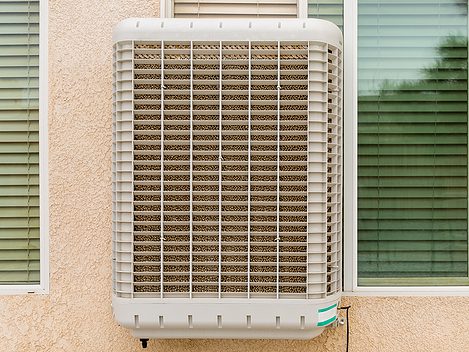
 A swamp cooler can leak water when the reservoir is overfilling, the float valve fails to shut off correctly, a water-supply connection is loose, the drain or overflow system leaks, the bottom pan is damaged, or water is being distributed improperly around the cooling pads. Mineral buildup and seasonal maintenance problems can also contribute to leaks. One of the best ways to narrow down the problem is to determine exactly where the water is coming from.
If you notice water dripping from your swamp cooler, pooling on the roof, running down the side of the unit, or even appearing inside your Albuquerque home, resist the temptation to immediately assume a particular part has failed.
Start with a simpler question:
Where Is the Water Coming From?
The location of the water can tell you much more than the fact that the cooler is leaking.
A useful troubleshooting sequence is:
Reservoir?
↓
Water-supply line?
↓
Drain or overflow?
↓
Cooling pads?
↓
Bottom pan?
↓
Roof?
↓
Inside the home?
This location-first approach is the primary diagnostic strategy established for this article because a swamp cooler has several places where water is supplied, stored, circulated, distributed, and drained.
Day & Night Plumbing, Heating & Cooling also emphasizes diagnosing the underlying cause before recommending repair or replacement. Its documented diagnostic approach includes inspection, system testing, identifying the cause, explaining repair options, receiving authorization, completing the appropriate work, and testing afterward.
That matters with a water leak because replacing the wrong part does not solve the real problem.
What Are the Most Common Places a Swamp Cooler Can Leak?
This table can help narrow the source.
| Where You See Water | Possible Cause |
| Reservoir overflowing | Float valve or water-level problem |
| Bottom of cooler | Pan, drain, overflow, fitting, or internal spill |
| Water-supply line | Loose or damaged line or fitting |
| Cooling pads | Excessive or uneven water distribution |
| Side of cabinet | Pad or distribution problem |
| Roof around cooler | Cooler, supply line, drain, or possibly roof-related source |
| Interior vent or duct | Water entering the duct or roof opening; source requires diagnosis |
| Leak after seasonal startup | Connection, float, drain, or maintenance issue |
The key principle is:
Start With the Leak Location—Not the Replacement Part
The article worksheet specifically identifies reservoir overflow, bottom-pan leaks, supply-line connections, cooling-pad distribution, and roof-area water as distinct diagnostic paths.
Why Is My Swamp Cooler Reservoir Overflowing?
If water is spilling from an overfilled reservoir, one of the first areas to investigate is the water-level control.
Many evaporative coolers use a float valve to regulate how much water enters the reservoir.
As water reaches the intended level, the float should cause the incoming water supply to stop.
If that process does not occur correctly, water can continue entering the cooler.
Eventually:
Water level rises
↓
Reservoir becomes too full
↓
Water reaches the overflow area or spills where it should not
Possible reasons can include:
- A float valve that is not shutting off correctly
- An improperly positioned float
- Water level set too high
- Mineral deposits interfering with float movement.
Do not assume there is one universal float adjustment that works for every swamp cooler.
Reservoir levels, float configurations, drains, overflows, and other specifications can vary by equipment. The production worksheet specifically instructs that manufacturer-specific reservoir or float specifications should not be generalized across every unit.
Can a Bad Float Valve Make a Swamp Cooler Leak?
Yes. A float valve that does not stop incoming water at the intended level can allow the reservoir to keep filling until water reaches the overflow area or spills elsewhere.
That does not necessarily mean every overflowing swamp cooler needs a new float valve.
The float may need to be inspected for:
- Movement
- Position
- Mineral accumulation
- Connection problems
- General condition
The important distinction is that an overflowing reservoir is different from a leak through a damaged component.
Overflow
Water continues entering until the level becomes too high.
Leak
Water escapes through a loose, damaged, deteriorated, or unintended path.
Both situations can leave water around the cooler, but they do not have the same cause.
Why Is My Swamp Cooler Leaking from the Bottom?
Water appearing underneath a swamp cooler can have several possible sources.
The bottom of the cooler typically contains or surrounds components related to the water reservoir and drainage system.
Possible causes can include:
- A deteriorated reservoir pan
- A drain fitting problem
- An overflow fitting
- A loose connection
- Water spilling internally and collecting in the bottom.
This is why it is useful to determine whether the water level in the reservoir appears normal.
If the reservoir is clearly too full, investigate the water-level or overflow issue.
If the water level appears normal but water continues appearing underneath the unit, then the pan, fittings, drain, overflow, or other water-handling components may deserve closer inspection.
With an older evaporative cooler, the pan and related components also need to be evaluated as part of the overall equipment condition.
Age alone does not prove that the pan is damaged, and an older cooler should not automatically be condemned.
Day & Night’s editorial standards specifically caution against treating every HVAC problem as a reason to replace the entire system. The company’s approach is to diagnose first and recommend repair, maintenance, or replacement based on the actual condition.
Can the Swamp Cooler Water-Supply Line Leak?
Yes.
Before water can be circulated inside the evaporative cooler, it first has to reach the unit.
A water-supply line or connection can potentially leak because of:
- A loose connection
- Damaged tubing
- A deteriorated fitting
- A seasonal reconnection problem.
This is particularly worth considering if the leak first appears when the swamp cooler is started for the cooling season.
The system may have remained dry or shut down for months. Once the water supply is restored, previously unnoticed connection problems can become visible.
If you see water originating directly from an accessible exterior supply connection, that may help narrow the problem quickly.
However, do not assume every puddle near a rooftop cooler is coming from the supply line. Water can travel across surfaces before becoming visible.
Why Is Water Dripping from My Swamp Cooler Pads?
Some water around the cooling media is expected because evaporative cooling relies on water being distributed across the pads.
Excessive dripping or water escaping outside the intended path is different.
Possible causes can include:
- Too much water being delivered
- Uneven distribution
- A pad that is not seated properly
- A water channel or distribution problem
- Clogged or mineral-coated distribution components.
The normal water path is approximately:
Water supply
↓
Reservoir
↓
Pump
↓
Distribution system
↓
Cooling pads
↓
Water returns toward the reservoir
A problem anywhere along that path can potentially cause water to go somewhere it was not intended to go.
This is also why a swamp cooler can have a cooling problem and a water problem at the same time.
Improper pad saturation or water distribution may result in both:
poor cooling
and
water dripping or spilling in the wrong location.
Can Dirty or Improperly Installed Cooling Pads Cause Dripping?
They can contribute to abnormal water distribution.
Cooling pads are supposed to receive water in a way that allows air to move through wetted media.
If the pads are installed incorrectly, deteriorated, restricted, or heavily coated with deposits, water may not spread through them normally.
Instead, it can:
- Concentrate in certain areas
- Run down one side
- Spill past the intended pad area
- Contribute to dripping around the cabinet
The correct pad type, position, and installation depend on the particular cooler.
This is another reason not to apply one model’s installation instructions universally.
Can Mineral Buildup Cause a Swamp Cooler Water Leak?
Mineral buildup can contribute to swamp cooler water-management problems.
Day & Night Plumbing, Heating & Cooling’s editorial profile specifically identifies hard water and mineral buildup as important conditions affecting plumbing and HVAC systems in Albuquerque and Central New Mexico.
As water circulates and evaporates, mineral deposits can accumulate on or around components.
Scale may potentially interfere with:
- Float movement
- Small water passages
- Distribution lines
- Cooling pads
- Fittings
- Drain or overflow areas.
That does not mean mineral buildup is the cause of every swamp cooler leak.
But it is a useful local factor to consider, especially if you see obvious deposits around water-handling components.
Mineral buildup can also contribute to other swamp cooler problems. Day & Night’s company knowledge base specifically identifies scale buildup, worn pads, pump failure, belt problems, and seasonal startup/shutdown issues among common evaporative cooler concerns.
Can a Swamp Cooler Pump Cause Water to Spray or Spill?
Potentially, but the presence of leaking water does not automatically mean the pump is defective.
The pump’s primary job is to circulate water from the reservoir through the distribution system and onto the cooling pads.
If water is being directed incorrectly, you may need to consider the entire circulation path:
Pump
Tubing
Distribution lines
Water channels
Cooling pads
A pump-related or water-distribution problem could cause abnormal water movement, but diagnosing the source before replacing the pump is important.
This is particularly relevant because pump problems are already common swamp cooler concerns documented in Day & Night’s knowledge base.
Why Is My Swamp Cooler Leaking After Spring Startup?
Seasonal startup is one of the most logical times for a water leak to become noticeable.
During the months when the swamp cooler is not operating, portions of the system may be dry or disconnected.
Once the cooler is prepared for summer and the water supply is restored, several problems can become apparent:
- Loose water connections
- Damaged tubing
- Float problems
- Drain or overflow issues
- Mineral accumulation
- Deteriorated components.
Day & Night’s company knowledge base specifically recognizes seasonal swamp-cooler startup and shutdown problems as common cooling concerns.
If the cooler was not leaking at the end of the previous cooling season but begins leaking immediately after startup, make note of that timing.
It is useful diagnostic information for the technician.
Why Is Water Pooling on the Roof Around My Swamp Cooler?
Water around a rooftop swamp cooler deserves attention, but it is important not to make an assumption based solely on location.
Water around the swamp cooler does not automatically prove the swamp cooler itself is leaking.
Possible sources can include:
- The cooler reservoir
- Water-supply line
- Drain or overflow
- Water-distribution components
- Other roof-area or flashing concerns.
The source should be identified before deciding who needs to repair it.
For example, if water can clearly be traced to a supply fitting, that is very different from water entering around a roof penetration when no evaporative-cooler component appears to be leaking.
Persistent water around a rooftop evaporative cooler should be corrected rather than allowed to continue because repeated moisture exposure can create additional maintenance concerns. That is the deliberately non-alarmist wording established by the article worksheet.
Why Is Water Coming Through My Swamp Cooler Vent?
Water appearing inside the home through a vent, duct, ceiling, or roof opening deserves prompt investigation.
Do not assume that the visible interior drip is directly beneath the actual source.
Water can travel along:
- Duct surfaces
- Structural components
- Roof penetrations
- Cooler transitions
- Plumbing lines
Possible sources may include the evaporative cooler itself, a water connection, a drainage problem, the duct transition, or another roof-area concern.
The article worksheet specifically directs that interior water should be diagnosed rather than attributed to one component without inspection.
If water is actively entering the home, shutting down the affected equipment and arranging professional evaluation may be appropriate, especially if water is near electrical components.
Can a Cracked or Damaged Swamp Cooler Pan Leak?
Yes, a damaged reservoir or pan can be one possible source of water beneath a swamp cooler.
The pan holds water as part of normal evaporative cooler operation.
If the pan, a fitting through the pan, or the drain area is damaged or deteriorated, water can escape.
However, seeing water underneath the cooler is not enough to prove the pan is cracked.
The same symptom can potentially come from:
- Overflow
- Loose fitting
- Drain connection
- Supply line
- Internal water spilling
- Distribution problem
That is exactly why the leak-location approach is preferable to immediately assuming the largest repair.
A leaking cooler may ultimately require an adjustment, maintenance, fitting repair, water-line repair, float service, drain repair, pan repair, or another targeted solution depending on the actual source.
What Can I Safely Check Before Calling for Swamp Cooler Repair?
Homeowners can make several useful observations without attempting electrical or mechanical repairs.
If it can be done safely, look for:
- Where the water first becomes visible
- Whether the reservoir appears unusually full
- Whether an accessible exterior supply line is dripping
- Whether water is coming from the drain or overflow
- Whether cooling pads appear to be receiving excessive or uneven water
- Whether visible mineral deposits are present
- Whether the leak began immediately after seasonal startup
- Whether water is entering the home
A simple sequence is:
- Is the reservoir overflowing?
- Is the water-supply line or fitting dripping?
- Is water coming from the drain or overflow?
- Are the cooling pads dripping excessively?
- Is water appearing beneath the bottom pan?
- Is water only visible on the roof?
- Is water entering the ductwork or house?
- Is professional diagnosis needed?
Those are the diagnostic steps established in the Universal Article Variables Worksheet.
There are also limits to DIY troubleshooting.
Do not climb onto a roof if you cannot access the cooler safely.
Do not perform live electrical testing, pump wiring work, or disassemble energized equipment.
If active water is near electrical components, professional service is the safer approach.
When Should I Call a Professional for a Leaking Swamp Cooler?
Consider professional swamp cooler service when:
- You cannot identify where the water originates
- The reservoir repeatedly overflows
- The float does not appear to control water properly
- A supply line or fitting is damaged
- Water continues leaking from the bottom of the cooler
- The drain or overflow system appears to be involved
- Water distribution over the pads is abnormal
- Mineral buildup is extensive
- Water is pooling repeatedly on the roof
- Water is entering ductwork or the home
- The leak returns after previous adjustment or maintenance
- Electrical components may be exposed to water
Day & Night Plumbing, Heating & Cooling provides swamp cooler repair, replacement, installation, evaporative cooler conversion, thermostat service, and cooling-system diagnosis as part of its cooling services.
Importantly, a leak does not automatically mean you need a new swamp cooler.
Day & Night’s editorial standards emphasize accurate diagnosis, quality workmanship, preventative maintenance, and practical recommendations rather than implying that every problem requires equipment replacement.
Can Regular Swamp Cooler Maintenance Help Prevent Water Leaks?
Regular maintenance can help identify conditions that may eventually contribute to water problems.
Seasonal swamp cooler service can provide an opportunity to inspect areas such as:
- Water-supply connections
- Reservoir
- Float operation
- Pump
- Water distribution
- Cooling pads
- Drain and overflow
- Mineral accumulation
- Seasonal startup condition
Day & Night lists HVAC maintenance, preventative maintenance, and seasonal tune-ups among its services.
Maintenance cannot guarantee that a component will never leak.
But an inspection can identify deteriorated tubing, heavy scale, problematic connections, water-level issues, or aging components before the problem becomes more disruptive.
This is particularly useful with evaporative coolers because Albuquerque’s climate makes seasonal startup and shutdown an important part of equipment ownership.
Frequently Asked Questions About Swamp Cooler Water Leaks
Why Is My Swamp Cooler Leaking Water?
Common causes include an overflowing reservoir, float-valve problem, loose water-supply connection, drain or overflow problem, damaged pan, or improper water distribution around the cooling pads. Mineral buildup and seasonal maintenance issues can also contribute. The leak location is often the best place to begin diagnosis.
Why Is My Swamp Cooler Overflowing?
The reservoir may continue filling because the float valve is not shutting the water supply off at the intended level. Float position, water level, or mineral buildup may also affect operation.
Can a Bad Float Valve Cause a Swamp Cooler Leak?
Yes. If the float does not stop incoming water at the intended level, the reservoir can overfill and water can reach the overflow area or spill where it should not.
Why Is My Swamp Cooler Leaking from the Bottom?
Possible causes include the reservoir pan, drain, overflow fitting, loose connection, or water spilling internally and collecting at the bottom.
Can Mineral Buildup Cause a Swamp Cooler Leak?
Mineral scale can potentially interfere with float movement, water passages, distribution lines, pads, fittings, and drain or overflow areas. However, visible mineral buildup does not automatically mean it is the source of the leak.
Why Is My Swamp Cooler Leaking After Startup?
Seasonal startup can reveal loose connections, damaged tubing, float problems, drain or overflow issues, mineral deposits, or components that deteriorated while the cooler was not operating.
Why Is Water Pooling Around My Swamp Cooler on the Roof?
Water may be coming from the cooler reservoir, water-supply line, drain, overflow, or distribution system, but a roof or flashing source is also possible. The location of the puddle alone does not identify the source.
Can a Swamp Cooler Leak Damage My Roof?
Persistent water around a rooftop evaporative cooler should be corrected because repeated moisture exposure can create additional maintenance concerns. The source should be identified rather than assuming the cooler or roof is automatically responsible.
Can I Repair a Swamp Cooler Leak Myself?
Some homeowners can safely identify obvious external dripping, a visibly overfilled reservoir, or a leaking accessible water connection. Electrical work, pump wiring, energized equipment, unsafe rooftop access, and unclear leaks are better handled professionally.
Does Day & Night Plumbing, Heating & Cooling Repair Leaking Swamp Coolers?
Yes. Day & Night’s documented cooling services include swamp cooler repair, replacement, installation, evaporative cooler conversion, thermostat service, and cooling-system diagnosis.
Swamp Cooler Leak Repair in Albuquerque
If your swamp cooler is leaking water, begin with the most useful question:
Where is the water coming from?
Is the reservoir overflowing?
Is the supply line dripping?
Is water coming from the drain or overflow?
Are the cooling pads receiving too much or uneven water?
Is the bottom pan wet?
Is water pooling around the cooler on the roof?
Or is water actually entering the home?
That sequence gives you a much better starting point than assuming that the pump, float, pan, or entire swamp cooler needs replacement.
Day & Night’s editorial and service standards emphasize practical troubleshooting, honest recommendations, experienced technicians, local Albuquerque knowledge, and long-term solutions rather than pressure-based selling. The company specifically serves Albuquerque and Central New Mexico and identifies hard water, mineral buildup, summer heat, evaporative cooling, and seasonal HVAC maintenance as important local service conditions.
Its internal linking guide also identifies Swamp Cooler Services as a primary service page and recommends connecting HVAC articles to relevant cooling services, maintenance information, Albuquerque location content, related articles, and the Contact/Get Quote page.
If water is repeatedly pooling around your evaporative cooler, the reservoir continues overflowing, a water line or fitting is leaking, water is entering the home, or you cannot determine where the leak is coming from, call Day & Night Plumbing, Heating & Cooling at (505) 974-5797 to schedule swamp cooler diagnosis and repair in Albuquerque or Central New Mexico. The company’s editorial profile lists its Albuquerque location at 2100 Aztec Rd. NE, Suite A, Albuquerque, New Mexico 87107.