An air conditioner rarely goes from working perfectly to completely failing without showing at least a few warning signs first.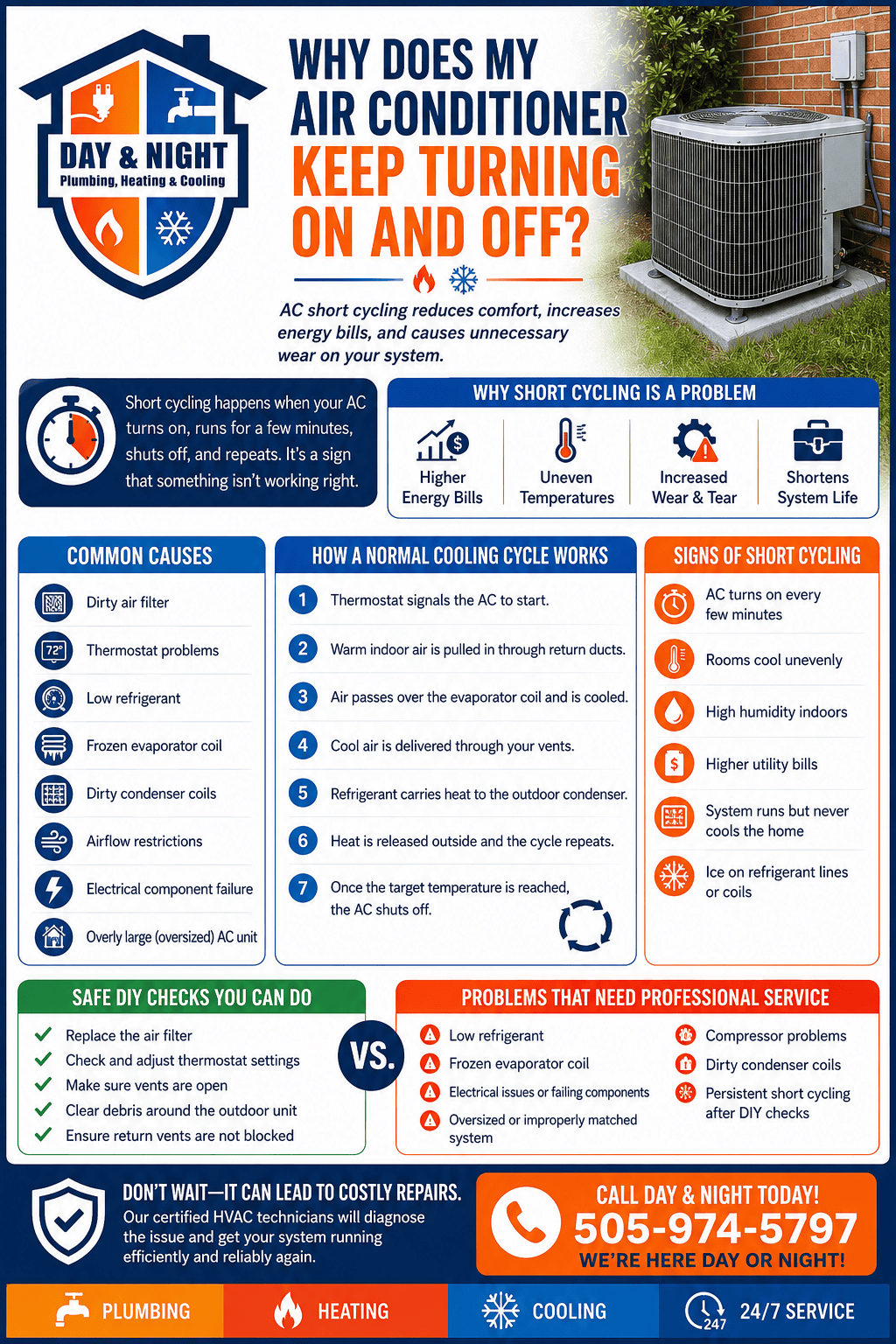
You may notice that the house takes longer to cool, certain rooms remain warmer than others, the air coming from the vents feels weak, or the system starts making a noise you have never heard before. Your electric bill may increase even though you have not changed the thermostat, or the air conditioner may begin turning on and off every few minutes.
These symptoms do not always mean the entire system needs to be replaced. A dirty filter, failing capacitor, clogged condensate drain, thermostat problem, or airflow restriction may be repairable. However, ignoring an early warning sign can place additional strain on the compressor, blower motor, condenser fan, and other expensive components.
The most common signs that an AC unit may be approaching failure include:
- Warm air coming from the vents
- Weak or uneven airflow
- Frequent on-and-off cycling
- Unusual sounds
- Unpleasant or burning odors
- Rising electric bills
- Water or refrigerant leaks
- Ice on the refrigerant lines or evaporator coil
- Difficulty maintaining the thermostat setting
- Frequent repairs or an aging system
The sooner these problems are investigated, the better the chance of correcting a smaller issue before it becomes a complete cooling-system breakdown.
That is especially important in Albuquerque and throughout Central New Mexico, where an air conditioner may operate for long periods during intense summer heat. A system that is already struggling can fail when outdoor temperatures and cooling demand reach their highest levels.
1. Your AC Is Blowing Warm or Lukewarm Air
Warm air from the vents is one of the clearest signs that an air-conditioning system is not operating correctly.
Before assuming the unit is failing, check the thermostat. Confirm that it is:
- Set to Cool
- Set below the current indoor temperature
- Not accidentally set to Fan Only
- Displaying normally
- Equipped with working batteries, if applicable
If the thermostat settings are correct and the air still feels warm, the problem may involve:
- Low refrigerant
- A refrigerant leak
- A dirty evaporator coil
- A failed compressor
- A malfunctioning capacitor
- An electrical problem
- Restricted airflow
- A damaged thermostat
- A disconnected or leaking duct
- An outdoor condenser that is not running
Some of these conditions are relatively straightforward to repair. Others, such as a failed compressor in an older system, may lead to a discussion about replacement.
Low refrigerant should not be treated as something that simply needs to be “topped off.” A properly operating sealed air-conditioning system does not routinely consume refrigerant. The Environmental Protection Agency advises homeowners to have technicians locate and repair refrigerant leaks rather than repeatedly adding more refrigerant.
Refrigerant work should be handled by an appropriately trained and EPA-certified technician.
2. The Airflow from Your Vents Is Weak
Weak airflow may make the home feel warm even when the air itself is cool.
You may notice:
- Very little air coming from one or more vents
- Rooms that never reach a comfortable temperature
- Strong airflow near the air handler but weak airflow farther away
- A system that runs continuously
- Whistling sounds from vents or ductwork
- Excessive dust near registers
Possible causes include:
- A dirty air filter
- A clogged evaporator coil
- A failing blower motor
- A damaged blower wheel
- Restricted return airflow
- Closed or blocked vents
- Crushed, disconnected, or leaking ductwork
- Improperly sized ducts
- High static pressure
- Heavy dust or debris buildup
A dirty filter is one of the first things a homeowner can safely check. When a filter becomes clogged, the blower has to work harder to move air through the system. Reduced airflow may also cause the evaporator coil to become too cold and freeze.
Replacing a dirty filter may restore performance when the restriction is minor. If airflow remains weak after the filter is changed and the vents are open, professional diagnosis is appropriate.
Day & Night Plumbing, Heating & Cooling provides air-conditioning diagnosis, repair, maintenance, duct evaluation, thermostat service, refrigerated-air work, mini-split service, and emergency HVAC response throughout Albuquerque and surrounding communities.
3. The Air Conditioner Keeps Turning On and Off
When an air conditioner starts, runs briefly, shuts off, and then restarts a few minutes later, it is commonly described as short cycling.
A normal air conditioner cycles as indoor temperatures change. Short cycling is different because the system does not remain on long enough to complete an effective cooling cycle.
Possible causes include:
- A dirty air filter
- An overheating component
- A thermostat installed in a poor location
- A failing capacitor
- Low refrigerant
- A frozen evaporator coil
- An electrical problem
- An oversized air conditioner
- A blocked condenser coil
- A failing compressor
Frequent starts place stress on motors, electrical components, and the compressor. The Air Conditioning Contractors of America notes that substantial equipment stress occurs during startup and that oversized systems may short cycle, increasing wear and contributing to premature failure.
An oversized system may cool the air near the thermostat quickly without running long enough to cool the rest of the house evenly. Improper sizing can also produce temperature swings, higher operating costs, and reduced equipment life.
Do not assume that installing a larger replacement system will solve comfort problems. Correct sizing should be based on the home’s cooling load, insulation, windows, orientation, ductwork, air leakage, and other building conditions.
4. You Hear New or Unusual Noises
Air conditioners make normal operating sounds. You may hear the outdoor fan, the indoor blower, air moving through the ducts, and a soft click when the system starts or stops.
New, loud, or persistent sounds deserve attention.
Banging or Clanking
A banging or clanking sound may indicate:
- A loose fan blade
- A damaged blower wheel
- A loose motor mount
- An internal compressor problem
- A component striking the cabinet
Grinding
Grinding can be associated with worn motor bearings or a blower motor problem. Continuing to operate a motor that is grinding may increase the damage.
Squealing or Screeching
Possible causes include:
- A worn belt on older equipment
- Motor-bearing failure
- Excessive pressure
- A failing fan motor
- Metal parts rubbing together
Buzzing
Buzzing may come from:
- A failing capacitor
- A contactor
- Loose electrical connections
- A struggling motor
- Debris near the outdoor fan
- A compressor that is having difficulty starting
Clicking That Does Not Stop
A single click at startup can be normal. Repeated clicking may point to a relay, contactor, thermostat, or electrical control problem.
Hissing or Bubbling
Hissing may indicate air escaping from ductwork or refrigerant escaping from a line or connection. Bubbling may be associated with a refrigerant or condensate issue.
Turn the system off and request professional service when noises are loud, sudden, accompanied by smoke or odor, or suggest that a moving part is hitting the equipment cabinet.
5. You Notice Burning, Musty, or Chemical Odors
An unusual odor does not always mean the air conditioner is about to fail, but it should not be ignored.
Burning Odor
A burning smell may indicate:
- Overheated wiring
- A failing motor
- Damaged insulation
- An electrical short
- A severely clogged filter
- Dust burning off after a long inactive period
A brief dusty smell at the first startup of the season can occur. A strong, persistent, or worsening burning odor is different.
Turn the system off and call for professional service if you smell burning plastic, hot wiring, or smoke.
Musty Odor
A musty smell may be associated with:
- Moisture in the ductwork
- A clogged condensate drain
- A dirty evaporator coil
- A wet drain pan
- Microbial growth in a damp area
- Poor indoor humidity control
The odor alone does not identify the exact source. The condensate system, evaporator coil, air handler, filter, and accessible ductwork may need to be inspected.
Chemical or Sweet Odor
An unfamiliar chemical odor may indicate a refrigerant, electrical, or other equipment issue. Do not attempt to identify or handle refrigerant yourself.
Day & Night Plumbing, Heating & Cooling’s editorial standards call for practical HVAC guidance that is accurate, helpful, and never alarmist. The company offers cooling-system diagnosis, indoor air-quality solutions, emergency HVAC service, and preventative maintenance.
6. Your Electric Bill Is Increasing
A higher electric bill does not automatically prove that an air conditioner is failing. Utility rates, outdoor temperature, thermostat settings, household occupancy, and other appliances can all affect energy use.
However, an unexplained increase during similar weather may indicate declining AC efficiency.
Possible causes include:
- A dirty filter
- A dirty evaporator or condenser coil
- Low refrigerant
- Leaking ductwork
- A failing motor
- A damaged capacitor
- An aging compressor
- Poor insulation or air sealing
- A thermostat problem
- An air conditioner running much longer than before
Compare bills from similar months rather than comparing a mild spring month to the hottest part of summer.
Also consider whether the air conditioner:
- Runs continuously
- Struggles to reach the setting
- Starts more frequently
- Produces less airflow
- Leaves some rooms uncomfortable
- Has required recent repairs
ENERGY STAR recommends professional evaluation when heating or cooling equipment is more than 10 years old or is no longer keeping the home comfortable. Frequent repairs combined with increasing energy bills are also indicators that replacement may deserve consideration.
7. Water Is Leaking Around the Indoor Unit
A refrigerated-air system removes moisture from indoor air. That moisture should collect at the evaporator coil and flow through the condensate drain.
Water near the indoor equipment may indicate:
- A clogged condensate drain
- A cracked drain pan
- A disconnected drain line
- A frozen evaporator coil melting
- Improper equipment installation
- Condensate-pump failure
- Excessive condensation
- A dirty coil or airflow restriction
Even a small condensate leak can damage:
- Drywall
- Flooring
- Insulation
- Wood framing
- Furnishings
- Nearby electrical components
Turn the system off if water is approaching electrical equipment or causing active property damage.
A clogged drain may be corrected without replacing the air conditioner. However, water combined with ice, weak airflow, warm air, or repeated shutdowns may indicate a broader cooling-system problem.
8. Ice Is Forming on the Refrigerant Line or Evaporator Coil
Ice on an air conditioner is not a sign that the system is cooling especially well. It indicates that the evaporator coil has dropped below freezing and moisture is turning to ice.
Common causes include:
- A dirty air filter
- Restricted airflow
- Closed or blocked vents
- A dirty evaporator coil
- A failing blower motor
- Low refrigerant
- A refrigerant leak
- Damaged ductwork
As the ice builds, airflow decreases further. The system may continue running without cooling the home effectively.
If you see ice:
- Turn off the cooling mode.
- Set the thermostat fan to On if the blower is operating normally.
- Replace a visibly dirty filter.
- Allow the coil to thaw completely.
- Keep water away from electrical components.
- Schedule professional service if the freezing returns.
Do not chip ice from the coil. The coil and refrigerant tubing can be damaged easily.
Do not continue running the system while it is frozen. Liquid refrigerant or abnormal operating conditions may eventually damage the compressor.
9. Your AC Cannot Maintain the Thermostat Setting
An air conditioner may run longer on the hottest afternoon of the year, especially when outdoor temperatures are well above normal. That alone does not prove failure.
Concern is more appropriate when the system previously maintained comfort under similar conditions but now cannot.
You may notice:
- The thermostat is set to 74 degrees, but the home remains at 80
- The system runs continuously
- Indoor temperatures rise each afternoon
- Some rooms stay much hotter than others
- The home cools only after sunset
- The system blows cool air but cannot keep up
Possible causes include:
- Dirty coils
- Low refrigerant
- Restricted airflow
- Leaking ducts
- Poor insulation
- Excessive air leakage
- A failing compressor
- An undersized system
- A thermostat problem
- Extreme heat gain through windows or the roof
- Mechanical wear in an older unit
Albuquerque’s high-desert climate places substantial demand on cooling systems during hot summer weather. Day & Night Plumbing, Heating & Cooling’s company standards specifically require familiarity with Albuquerque heat, high-desert conditions, seasonal HVAC maintenance, evaporative cooling, older neighborhoods, and local building practices.
A technician should evaluate both the equipment and the home’s airflow. Replacing parts without identifying duct or building-envelope problems may not restore comfort.
10. The Outdoor Unit Is Not Running Correctly
The outdoor condenser releases heat collected from inside the home. If it is not operating correctly, the system may blow warm air or stop cooling altogether.
Possible warning signs include:
- The indoor fan runs but the outdoor unit does not
- The outdoor fan does not spin
- The compressor hums but does not start
- The unit starts only after several attempts
- The breaker repeatedly trips
- The cabinet vibrates heavily
- The system makes loud buzzing or clicking sounds
- The condenser shuts off unexpectedly
Potential causes include:
- A failed capacitor
- A damaged contactor
- A tripped breaker
- Wiring problems
- A failing fan motor
- A locked or failing compressor
- An overheated component
- A thermostat or control problem
Homeowners can check whether the HVAC breaker has tripped, but repeatedly resetting a breaker is not a repair. A breaker that trips again may be responding to an electrical fault or excessive current draw.
Keep hands and tools away from the condenser fan and electrical compartment. Capacitors can retain an electrical charge even after power has been disconnected.
11. Your Home Has Hot and Cold Spots
Uneven temperatures may occur when:
- Ducts are leaking
- Dampers are incorrectly adjusted
- The blower is weak
- The filter is clogged
- Return-air pathways are inadequate
- The system is improperly sized
- Insulation varies between rooms
- Windows allow excessive heat gain
- The thermostat is poorly located
- The cooling equipment is losing capacity
If one room has always been warmer, the problem may involve system design or the room itself. If the uneven cooling is new, it may be an early sign of declining airflow or equipment performance.
A professional evaluation may include:
- Temperature measurements
- Airflow readings
- Static-pressure testing
- Duct inspection
- Filter inspection
- Coil evaluation
- Thermostat testing
- Equipment-capacity testing
Modern diagnostic equipment allows experienced technicians to measure performance rather than relying only on guesswork. Day & Night Plumbing, Heating & Cooling’s company profile emphasizes experienced technicians, modern diagnostics, long-term repair solutions, and honest recommendations.
12. The System Needs Repairs More Frequently
A single repair does not necessarily mean replacement is needed. Many air conditioners operate reliably for years after replacing a capacitor, contactor, fan motor, thermostat, or another serviceable component.
The pattern matters.
Replacement may deserve consideration when:
- Repairs occur every cooling season
- Several major components are deteriorating
- The compressor is failing
- Refrigerant leaks keep returning
- Replacement parts are difficult to obtain
- The system uses an older refrigerant
- Energy use continues to rise
- Comfort remains poor after repairs
- The equipment is more than 10 years old
- Repair costs are becoming difficult to justify
ENERGY STAR identifies equipment older than 10 years, frequent repairs, rising energy bills, and difficulty maintaining comfort as reasons to consider replacement.
Age alone should not determine the answer. A well-maintained older system with a minor repair may remain useful. A poorly maintained younger system with compressor damage may be a weaker candidate for additional investment.
Common AC Warning Signs at a Glance
| Warning sign | Possible causes | Recommended response |
| Warm air | Refrigerant, compressor, thermostat, electrical problem | Schedule diagnosis |
| Weak airflow | Filter, blower, coil, ducts | Check filter and request service |
| Short cycling | Electrical, sizing, overheating, refrigerant | Avoid delaying inspection |
| Loud noises | Fan, motor, compressor, loose component | Turn off if severe |
| Burning odor | Wiring or motor problem | Turn off and request urgent service |
| Musty odor | Drain, coil, moisture, duct issue | Inspect condensate and air handler |
| Rising power bills | Reduced efficiency, long runtime | Compare usage and schedule maintenance |
| Water around unit | Condensate blockage, frozen coil | Protect property and request repair |
| Ice on lines | Airflow or refrigerant issue | Turn cooling off and allow thawing |
| Cannot maintain temperature | Capacity, airflow, mechanical, duct issue | Request full system diagnosis |
| Outdoor unit not running | Electrical, motor, compressor | Do not repeatedly reset breaker |
| Frequent repairs | Aging or deteriorating system | Compare repair and replacement |
Which Problems Are Usually Repairable?
Many AC warning signs are caused by repairable problems.
Common repairs may include:
- Replacing a dirty filter
- Cleaning the evaporator or condenser coil
- Clearing a condensate drain
- Replacing a capacitor
- Repairing a contactor
- Replacing a fan motor
- Repairing thermostat wiring
- Replacing a thermostat
- Sealing accessible duct leaks
- Correcting electrical connections
- Repairing and properly recharging a refrigerant system
- Replacing a condensate pump
A complete diagnosis is important because one symptom can have several causes.
For example, warm air could result from a thermostat setting, a failed capacitor, a refrigerant leak, a compressor problem, or an outdoor unit that has lost power. Replacing parts without testing the system may waste money and leave the actual problem unresolved.
When Might AC Replacement Be the Better Choice?
Replacement may be more practical when several factors occur together.
| Situation | Repair may make sense | Replacement may make sense |
| Dirty filter or coil | Usually | Rarely |
| Failed capacitor | Usually | If multiple major problems also exist |
| Thermostat problem | Usually | Only when part of a larger system upgrade |
| Minor drain problem | Usually | Rarely |
| Fan motor failure | Often | If system is old and inefficient |
| Refrigerant leak | Sometimes | If leak is major or system is aging |
| Compressor failure | Sometimes | Often on older equipment |
| Multiple annual repairs | Less likely | Often |
| System over 10 years old | Depends on condition | Worth evaluating |
| Poor comfort and high bills | Repair if cause is correctable | Replacement may improve performance |
| Obsolete or unavailable parts | Difficult | Often |
| Improperly sized equipment | Repairs may not solve design problem | Properly sized replacement may help |
A responsible recommendation should consider:
- Equipment age
- Repair cost
- Overall system condition
- Energy efficiency
- Refrigerant type
- Availability of parts
- Previous repair history
- Comfort performance
- Duct condition
- How long the homeowner expects to remain in the property
Day & Night Plumbing, Heating & Cooling positions itself as an honest advisor and practical problem solver rather than competing primarily on price or recommending replacement automatically.
What Can You Check Before Calling an HVAC Technician?
Homeowners can safely perform a few basic checks.
Confirm the Thermostat Settings
Make sure the thermostat is on Cool, the temperature setting is below the indoor temperature, and the fan is set as intended.
Check the Air Filter
Replace a visibly dirty filter with the correct size and type.
Check the Breaker Once
If the HVAC breaker has tripped, you may reset it once. Do not continue resetting a breaker that trips repeatedly.
Open Supply and Return Vents
Do not block vents with furniture, rugs, or curtains.
Inspect the Outdoor Unit from a Safe Distance
Remove loose leaves or debris from around the cabinet, but do not open the equipment or reach through the fan guard.
Look for Ice or Water
Turn the cooling off if the system is frozen or water is threatening electrical components or property.
Note What the System Is Doing
Helpful information includes:
- When the problem began
- Whether the outdoor unit runs
- What noises you hear
- Whether air is warm or cool
- Whether the filter was recently changed
- Whether the breaker tripped
- Whether ice or water is visible
- Whether the thermostat displays an error
These observations help the technician begin the diagnostic process.
What Should You Not Try Yourself?
Avoid working inside the outdoor unit, air handler, electrical panel, or refrigerant circuit unless you are properly trained and qualified.
Do not attempt to:
- Open capacitor compartments
- Bypass safety controls
- Add refrigerant
- Repair refrigerant lines
- Replace electrical contactors
- Test live high-voltage components
- Force a frozen system to keep running
- Reach into a moving fan
- Repeatedly reset a tripping breaker
- Use incompatible replacement parts
The EPA advises homeowners to use technicians who are certified to handle refrigerants. Proper leak repair also reduces refrigerant emissions, energy use, and the likelihood of repeated service calls.
How Preventative Maintenance Helps Prevent AC Failure
Preventative maintenance cannot guarantee that an air conditioner will never break down, but it can identify many developing problems before they cause a complete loss of cooling.
A professional tune-up may include:
- Filter inspection
- Thermostat testing
- Electrical-connection inspection
- Capacitor testing
- Motor inspection
- Temperature measurements
- Refrigerant-system evaluation
- Evaporator and condenser coil inspection
- Condensate-drain inspection
- Blower inspection
- Airflow evaluation
- System-startup testing
- Review of unusual noises or vibration
Maintenance is especially valuable before Albuquerque’s hottest weather begins. A weak capacitor, dirty coil, clogged drain, or worn motor may continue operating during mild spring conditions but fail when the system begins running for long periods.
Day & Night Plumbing, Heating & Cooling provides seasonal tune-ups, AC maintenance, preventative maintenance, cooling-system diagnosis, repair, installation, refrigerated-air conversions, ductless mini-split service, swamp cooler work, and 24-hour emergency HVAC response.
Frequently Asked Questions
What are the first signs that an AC unit is failing?
Common early signs include longer run times, weak airflow, warmer air, uneven temperatures, unfamiliar noises, higher electric bills, short cycling, and difficulty maintaining the thermostat setting.
Why is my AC blowing warm air?
Possible causes include an incorrect thermostat setting, low refrigerant, a refrigerant leak, a failed compressor, dirty coils, restricted airflow, or an outdoor condenser that is not operating.
Why does my air conditioner keep shutting off?
The system may be short cycling because of a dirty filter, electrical problem, thermostat issue, frozen coil, overheating component, refrigerant problem, or improper equipment sizing.
Can a dirty filter make my AC seem broken?
Yes. A heavily clogged filter can reduce airflow, increase system strain, cause weak cooling, and contribute to a frozen evaporator coil.
What does a failing AC compressor sound like?
Compressor problems may cause loud buzzing, hard starting, rattling, clanking, or unusual vibration. Noise alone cannot confirm compressor failure, so professional testing is necessary.
Can a refrigerant leak damage the air conditioner?
Yes. Low refrigerant can reduce cooling, contribute to coil freezing, increase operating time, and create conditions that may damage the compressor. The leak should be found and repaired rather than repeatedly recharging the unit.
How old is too old for an air conditioner?
There is no single expiration date. However, ENERGY STAR recommends professional evaluation when equipment is more than 10 years old or no longer maintains comfort efficiently.
Should I repair or replace my AC?
The decision depends on age, repair cost, system condition, efficiency, refrigerant type, comfort, previous repairs, and the availability of parts. A professional diagnosis should come before the decision.
How often should an AC system receive maintenance?
Most residential systems benefit from professional maintenance at least once each year, preferably before the cooling season. Follow the equipment manufacturer’s instructions and any warranty requirements.
Does Albuquerque’s climate shorten AC life?
Albuquerque’s intense summer heat, dust, high-desert conditions, and long cooling periods can place significant demand on air-conditioning equipment. Regular filter replacement, coil care, airflow evaluation, and seasonal maintenance can help reduce unnecessary strain.
When is an AC problem an emergency?
Request urgent service when there is a burning smell, smoke, sparking, repeated breaker trips, water near electrical equipment, severe equipment vibration, loss of cooling during dangerous heat, or another condition that could threaten safety or property.
Do Not Wait for a Complete AC Breakdown
A warm room or strange noise does not automatically mean your air conditioner must be replaced. Many problems can be corrected when they are diagnosed early.
The warning signs become more concerning when several occur together:
- The system is older
- Repair frequency is increasing
- Utility bills are rising
- Airflow is weakening
- The unit cannot maintain comfort
- Refrigerant leaks are recurring
- The compressor is struggling
- Parts are difficult to obtain
Waiting until the air conditioner stops completely can limit your options. Emergency breakdowns often occur during the hottest weather, when the system is working hardest and HVAC appointment schedules are busiest.
Early diagnosis gives you time to compare repair and replacement options, plan the work, and make a decision based on long-term comfort rather than immediate pressure.
Schedule Professional AC Service with Day & Night Plumbing, Heating & Cooling
If your air conditioner is blowing warm air, making unfamiliar noises, cycling constantly, leaking water, freezing up, or struggling to keep your home comfortable, contact Day & Night Plumbing, Heating & Cooling for professional diagnosis and service.
The company provides residential and commercial plumbing and HVAC services with experienced technicians, modern diagnostic equipment, honest recommendations, long-term repair solutions, and 24-hour emergency response for critical problems.
Day & Night Plumbing, Heating & Cooling serves Albuquerque, Rio Rancho, Corrales, Bernalillo, Los Ranchos de Albuquerque, the North Valley, South Valley, Westside Albuquerque, the East Mountains, Los Lunas, Placitas, Edgewood, Tijeras, Bosque Farms, Moriarty, and surrounding Central New Mexico communities.
The company’s internal linking strategy connects this article with AC repair, air-conditioning installation, air-conditioning maintenance, emergency HVAC service, indoor air quality, the Albuquerque service page, related cooling articles, and the company’s contact page.
Day & Night Plumbing, Heating & Cooling
2100 Aztec Road NE, Suite A
Albuquerque, NM 87107
Phone: (505) 974-5797
Call Day & Night Plumbing, Heating & Cooling today to schedule professional air-conditioning service and find out whether your system needs maintenance, repair, or replacement.